Innovation Insights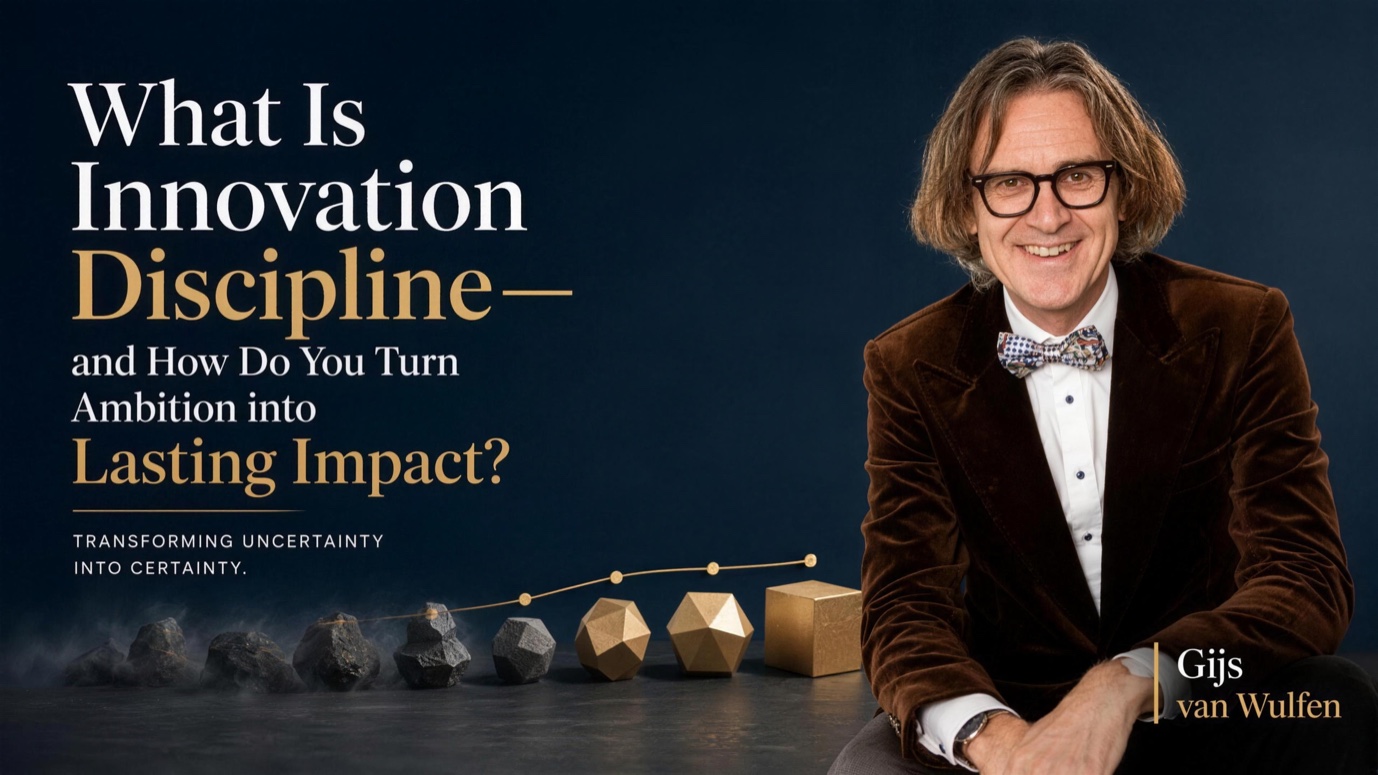
Why Does Innovation Need Discipline—and How Can Organisations Build It?
Creativity builds the dream. Discipline delivers the impact.
Creativity builds the dream. Discipline delivers the impact.
Innovation is usually associated with creativity, freedom, breaking rules and thinking outside the box. That is understandable. Every innovation starts with imagining something that does not yet exist.
But creativity is only the beginning. Innovation is the transformation of ideas into impact. That transformation requires commitment, collaboration, experimentation, perseverance and delivery. Without these disciplines, organisations may generate attractive ideas, inspiring workshops and promising prototypes—but they do not innovate.
After more than 25 years of leading innovation projects, I define innovation discipline as:
The shared, purposeful and persistent transformation of innovative concepts into real impact, despite great uncertainty.
Innovation discipline does not eliminate uncertainty at the start. It gives people a structured way to move through it. Teams convert assumptions into evidence, evidence into commitment and commitment into delivery.
Five disciplines are essential:
Together, they turn innovation from an occasional creative event into a repeatable organisational capability.
Mention innovation and familiar images appear: a light bulb, a creative workshop, colourful notes on a wall and people being encouraged to think outside the box. Innovation is associated with freedom, imagination, breaking rules and coming up with something completely new.
And that is right. It is a great start. Creativity allows us to build a dream.
But a dream is not yet an innovation.
The OECD makes the distinction clearly: innovation is more than a new idea or invention. It requires implementation—something must be introduced to the market or put into active use. The economic and social value of an idea depends on its adoption and diffusion. In other words, novelty alone is not enough. An idea becomes an innovation only when it creates value in practice.
That is precisely where discipline enters.
Without delivery, you are a dreamer. You are not an innovator.
Creativity helps us imagine what might be possible. Innovation discipline enables us to make it possible, practical, desirable, viable and scalable. Perhaps more important than the creativity to start is the discipline to deliver.
This does not mean suppressing imagination beneath procedures, forms and rigid controls. Innovation discipline is not bureaucracy. It is purposeful movement through uncertainty.
My definition is:
Innovation discipline is the shared, purposeful and persistent transformation of innovative concepts into real impact, despite great uncertainty.
Every word matters. Shared means innovation becomes WE-nnovation: people across disciplines learn, decide and act together. Purposeful means experimentation serves a meaningful customer problem, organisational challenge or opportunity; the route may change, but the purpose remains the compass. Persistent means continuing to learn and adapt when attempts fail—not blindly repeating the same action. Impact means progressing beyond a concept, prototype, pilot or approved business case until the innovation creates value in practice and at scale.
At the start of a radical innovation journey, almost everything important is uncertain. We may have an attractive concept and a convincing presentation, but we still do not know whether:
Even an approved business case may still consist largely of assumptions. A spreadsheet can make assumptions look precise without making them true.
The role of an innovator is to transform uncertainty into certainty.
This is done through validation and experimentation. Each well-designed experiment converts an important assumption into stronger evidence. As the evidence grows, uncertainty falls. That gives leaders, investors, partners and customers more confidence to commit to the next step.
Innovation discipline is therefore a chain:
assumptions → experiments → evidence → commitment → delivery → impact
It is not possible—or desirable—to demand complete certainty at the beginning. If everything were already known, it would not be innovation. The task is to create sufficient evidence for the next responsible decision.
Established organisations are usually disciplined already. They manage budgets, specifications, quality, productivity, safety, delivery and performance. Why, then, do they struggle with innovation?
The discipline itself is not fundamentally different. Both operational and innovation discipline require focus, ownership, measurement and follow-through. The decisive difference is the degree of familiarity.
In the existing business, the organisation knows its customers, products, processes, people and expected deliverables. Operational excellence improves that familiar system. It reduces costs, accelerates delivery, improves quality and perfects the final details.
The question is: How can we do what we already do even better?
Innovation concerns a new product, service, process, technology, customer group or business model. The organisation has little or no direct experience on which to rely.
The question becomes: How can we discover whether this can work at all?
That requires several kinds of validation:
Operational discipline improves what an organisation already knows. Innovation discipline proves what an organisation does not yet know.
The disciplines must eventually meet. Once an innovative concept has been validated, the organisation must transform innovation discipline into operational excellence. A working prototype must become a dependable product. A successful pilot must become a repeatable service. A small-scale process must become an operation capable of delivering consistently.
This transition is where many innovations become stranded.
Innovation usually loses its discipline when it stops being exciting and starts becoming difficult.
The first stage is attractive: people explore trends, meet customers, generate ideas and build prototypes. Then an experiment fails, a customer rejects the proposition, regulation creates a delay or key people are pulled back into urgent operational work.
Most corporate innovators work on the business of tomorrow while remaining responsible for the business of today. Their innovation commitment is part-time; their operational responsibilities are immediate and measurable. When pressure rises, today usually wins.
This is precisely the moment when innovation discipline matters most.
A failed outcome does not necessarily mean a failed experiment. If an experiment disproves an assumption and reveals what must change, it has produced valuable learning.
James Dyson famously developed 5,127 prototypes over five years while creating his bagless vacuum technology. The number is memorable, but the underlying lesson matters more: breakthrough innovation requires the willingness to learn repeatedly from what does not yet work.
The real difficulty often begins after the minimum viable product. Demonstrating that something works once is different from producing it safely, affordably and repeatedly. Scaling may require a factory, digital infrastructure, trained employees, regulatory approval and a new value chain.
A prototype proves possibility. Scaling delivers impact.
Based on my experience, organisations need five interconnected disciplines to transform an innovative concept into impact.
Saying yes to a business case is easy. Delivering that business case is difficult.
Radical innovation is a long journey. It may take three to five years to reach the market and another three to five years to earn back the initial investment. During that period, leadership changes, reorganisations happen, budgets tighten and the daily business comes under pressure.
Commitment means protecting the innovation through those changes. It includes:
The greatest test comes when today’s results disappoint. Repeatedly sacrificing tomorrow to rescue today ultimately creates a business with no future.
The market you will need in the next decade must be built today.
Leaders demonstrate commitment through presence. They should not appear only to sign an agreement, open a factory or pose for the success photograph. When a prototype fails or resistance grows, they should celebrate the learning, restore confidence and protect the project’s priority.
Commitment also works in two directions. Leaders provide protection, resources and confidence. Innovation teams provide transparent progress and the evidence leaders need to maintain support from executives, boards and investors.
Long-term commitment must be sustained by short-term evidence.
Innovation is always 360 degrees.
A radical proposition may require technological innovation, process innovation, commercial innovation, financial innovation, IT innovation, logistical innovation and even legal or regulatory innovation. These elements depend on each other. Optimising only the technology will not produce a successful business.
This is why trust and collaboration are disciplines, not cultural luxuries.
People trust an innovation more deeply when they understand how it was created. When colleagues have explored the customer problem, considered the alternatives and examined the evidence themselves, they do not merely receive somebody else’s conclusion. They develop ownership.
They must also trust one another. An engineer must trust the customer evidence. A commercial leader must respect technological constraints. Finance must help test a new business model instead of applying only the assumptions of the existing one. Legal specialists must help create a responsible route forward instead of appearing at the end with a list of objections.
Handing a finished concept from an isolated innovation team to the rest of the organisation rarely works. The receiving functions did not join the learning journey. They see risks the innovators may have missed, while the innovators experience their questions as resistance. The resulting “not invented here” response can kill even a promising concept.
WE-nnovation brings the required people into the journey early. It creates shared learning, shared evidence and shared ownership.
The first business case is built on assumptions. Disciplined experimentation transforms those assumptions into proof.
Teams should test the assumptions that are simultaneously most important and most uncertain. There is little value in perfecting easy details while one decisive customer, technical or financial assumption could invalidate the entire concept.
A practical sequence is:
Early experiments should be small and fast. Their purpose is learning, not perfection. As the concept approaches launch, experiments must become increasingly realistic. Technical demonstrations need to progress towards production conditions; positive customer reactions need to progress towards customer commitments and payments.
Keep experiments small enough to maintain speed, but make them realistic enough to produce credible evidence.
Strong evidence may include a launching customer, a paid prototype, customer investment, a functioning minimum viable product, reliable small-scale production or validated unit economics.
Experimentation must lead to decisions:
Innovation theatre produces demonstrations without decisions. Disciplined experimentation creates evidence that changes what the organisation does next.
There is a thin line between perseverance and stubbornness.
Innovators need a powerful drive. Their role is often to transform noes into yeses. They persist through rejection because the goal matters and because radical ideas initially conflict with familiar assumptions, established interests and existing systems.
But innovators must also remain realistic and view the evidence from more than one side.
After an unsuccessful experiment, ask:
Knowing what we know now, which credible options remain?
A temporary failure creates valuable learning while leaving promising routes forward. A pivot is necessary when the purpose remains valid but the technology, market, customer group, financial model or delivery route must change. A dead end is reached when repeated experiments and pivots have reduced uncertainty, yet a decisive obstacle remains unsolvable.
Perseverance is especially challenging in public companies. Quarterly performance expectations and annual budget cycles repeatedly place long-term innovation under scrutiny. Family businesses may have an advantage because they can think in generations rather than quarters.
Whatever the ownership structure, innovators need cadence:
Innovation is a marathon that must be run as a series of sprints.
The long-term purpose sustains perseverance. Short-term goals create urgency, learning and visible progress. Teams and leaders can then renew their commitment one evidence-based step at a time.
Real discipline also includes the courage to stop. Continuing a cherished project after credible routes have disappeared is not perseverance. It is stubbornness.
Organisations often celebrate the wrong finish line.
They celebrate the idea, the hackathon winner, the prototype, the pilot or the approved business case. These are valuable milestones—but they are not impact.
The business case is where the creative front end ends and the real delivery work begins. The organisation must now build the product, service, process, operation or ecosystem that can perform reliably in the real world.
Impact requires ownership beyond the innovation team. The people responsible for production, sales, service, IT, finance, legal affairs and operations must be ready to scale what has been validated. Senior leaders must make resources available and remove organisational obstacles. Customers and partners may need to join the final development.
The objective is not merely an output. It is a meaningful outcome at scale—for customers, patients, citizens, employees or society.
Bruil’s development of 3D-printed architectural concrete in the Netherlands shows the five disciplines in action.
During the construction crisis, Bruil explored new ways to strengthen its future market position. A FORTH innovation project produced five business cases. The most radical was a dream: use 3D printing to create architectural concrete with the organic freedom associated with Antoni Gaudí—without relying on expensive, single-use moulds.
At the time, printing architectural concrete at this scale was far from proven. Plastic 3D printing was familiar, but Bruil did not yet know how to control concrete mixtures, printing speed, layer behaviour, geometry, tolerances and finish sufficiently for dependable architectural production.
The organisation began testing in 2015. Its technologists worked on mortar formulations. Engineers developed the printing system and a specialised print head. Software expertise was added. Early elements were tested and demonstrated. Each step replaced another assumption with evidence.
But technical feasibility was only one part of the challenge.
Architects needed design freedom. Engineers had to establish structural integrity. Contractors needed elements that could be transported and installed. Property owners needed an affordable and durable solution. Residents wanted better balconies and attractive homes. The complete proposition also involved digital modelling, logistics, regulations, production capacity and commercial viability.
Bruil could not build this value chain alone.
The opportunity became concrete at the Hendrik Baskeweg in Den Helder, the Netherlands. Two ageing apartment buildings—De Wadden and De Duinen—needed extensive renovation. Architect Kokon envisioned a dramatic transformation inspired by Gaudí’s flowing forms. Traditional mould-based production would have made the many unique shapes prohibitively expensive. Concrete printing offered a new route.
Bruil, Kokon Architectuur & Stedenbouw, Helder Vastgoed, contractors, structural engineers and other specialists had to learn together, solve interdependent problems and maintain trust.
Bruil opened a dedicated 3D-concrete-printing factory in Veenendaal in 2019. The production system progressed from laboratory experimentation to industrial delivery. The Hendrik Baskeweg project ultimately involved 154 apartments and roughly 1,200–1,400 printed concrete elements in more than 200 different forms.
The result was not a technical demonstration. Two monotonous 1970s flats became sculptural, contemporary buildings with larger balconies, improved sustainability and an expected additional useful life of around 50 years.
In 2026, the project received three New York Architectural Design Awards: gold for residential historical restoration, silver for innovative architecture using 3D printing and robotic fabrication, and silver for its 3D-printed conceptual design.
The journey completed the full innovation cycle:
It travelled from a radical dream in a FORTH innovation project to an award-winning concrete reality in Den Helder.
This is innovation discipline.
What keeps an innovation team motivated over such a long journey?
Progress.
Progress makes uncertainty smaller and the destination more credible. A confirmed customer problem, a successful technical test, a paid prototype, an approved permit or a reliable production run gives the team new energy. It also gives leaders reasons to maintain their commitment.
Urgency creates the focus required to make that progress.
When an organisation merely wants to innovate, ambition may be high but priority can remain low. When it needs to innovate, people understand the consequences of doing nothing. They see the lions coming.
That creates positive pressure. The innovation receives attention, resources and priority over less important daily tasks.
In my experience, urgency works more powerfully than ambition. If stopping innovation will not hurt the organisation for another five or ten years, today’s problems easily take precedence. By the time the consequences become urgent, the organisation may have lost the time required to build its next platform or market.
Leaders must therefore make the future tangible. They should ask:
Ambition starts innovation. Urgency accelerates it. Progress sustains it. Discipline delivers its impact.
Innovation discipline grows through repeated behaviour.
Innovation needs creativity. It needs people who can imagine something new, challenge familiar assumptions and build a compelling dream.
But that is only the beginning.
Innovators must then travel through uncertainty. They must secure long-term commitment, build trust across disciplines, convert assumptions into evidence, persevere through setbacks and scale a validated concept into real-world delivery.
That is why innovation discipline matters.
It is not the enemy of creativity. It is what gives creativity consequence.
Without creativity, there is no dream. Without discipline, there is no delivery.
Innovation discipline is the shared, purposeful and persistent transformation of innovative concepts into real impact, despite great uncertainty. It combines collaboration, experimentation, evidence-based decisions, perseverance and delivery.
Creativity produces ideas, but innovation requires implementation. Discipline helps teams validate assumptions, overcome setbacks, secure continued commitment and scale a concept until it produces meaningful impact.
No. Effective innovation discipline protects creativity while giving it direction and consequence. It provides structure for exploring uncertainty without prescribing the final answer in advance.
Operational discipline improves products and processes the organisation already understands. Innovation discipline tests and validates new products, technologies, customer groups, processes or business models under conditions of high uncertainty.
The five disciplines are: Commit; Trust and collaborate; Experiment; Persevere; and Deliver impact. Weakness in any one of them can prevent a promising concept from reaching the market or creating value.
New business cases are built on assumptions. Experiments create evidence about customer relevance, technological feasibility, willingness to pay, business viability, production and scalability. This evidence supports responsible continue, pivot or stop decisions.
Test assumptions that are both highly important and highly uncertain. A decisive customer, technological or financial uncertainty should be addressed before the team invests time in less consequential details.
Not necessarily. A failed outcome can be a successful experiment if it disproves an important assumption, produces valuable learning and helps the team make a better decision.
Stop when repeated experiments and pivots show that a decisive market, technological, financial or delivery obstacle cannot realistically be overcome, or when the evolving concept no longer serves the original strategic purpose.
Leaders should remain visible and accessible, protect people and budgets, establish short-term evidence goals, celebrate learning, remove obstacles and maintain support during setbacks—not merely appear when the innovation succeeds.
Scaling must be prepared before the pilot ends. The organisation should involve production, sales, service, IT, finance, legal and delivery functions early, validate real operating conditions and assign clear ownership for implementation and growth.
Gijs turns this thinking into a keynote or a workshop, tailored to your audience. Four talks, each built for a different problem.
Winning management buy-in and turning approved ideas into action.
The FORTH roadmap: choosing the right opportunity before the team builds the wrong thing well.
Leading innovation when the map is out of date.
How great innovators see the opportunities others miss.
“A brilliantly articulated presentation full of passion, emotion and metaphors.”Ignacio Villoch · BBVA Innovation Centre, Spain
“Gijs creates an innovative mindset throughout the audience.”Anne-Laure Pardijon · Leadership Talent Programmes Manager, Airbus Group, France
Thirty to sixty minutes as a keynote, two to four hours as a workshop. Tell him the date, the audience and the format.
Gijs van Wulfen is an innovation keynote speaker, author and founder of the FORTH Innovation Methodology. For more than 25 years, he has helped organisations break innovation barriers, strengthen innovation discipline and transform innovation ambition into practical results.
He is the author of several books on innovation, including The Innovation Expedition, The Innovation Maze and Breaking Innovation Barriers: Fifteen Strategies to Win Management Buy-In for Change. The FORTH Innovation Methodology was developed from his practical experience of leading innovation projects and is used by organisations and certified facilitators around the world.