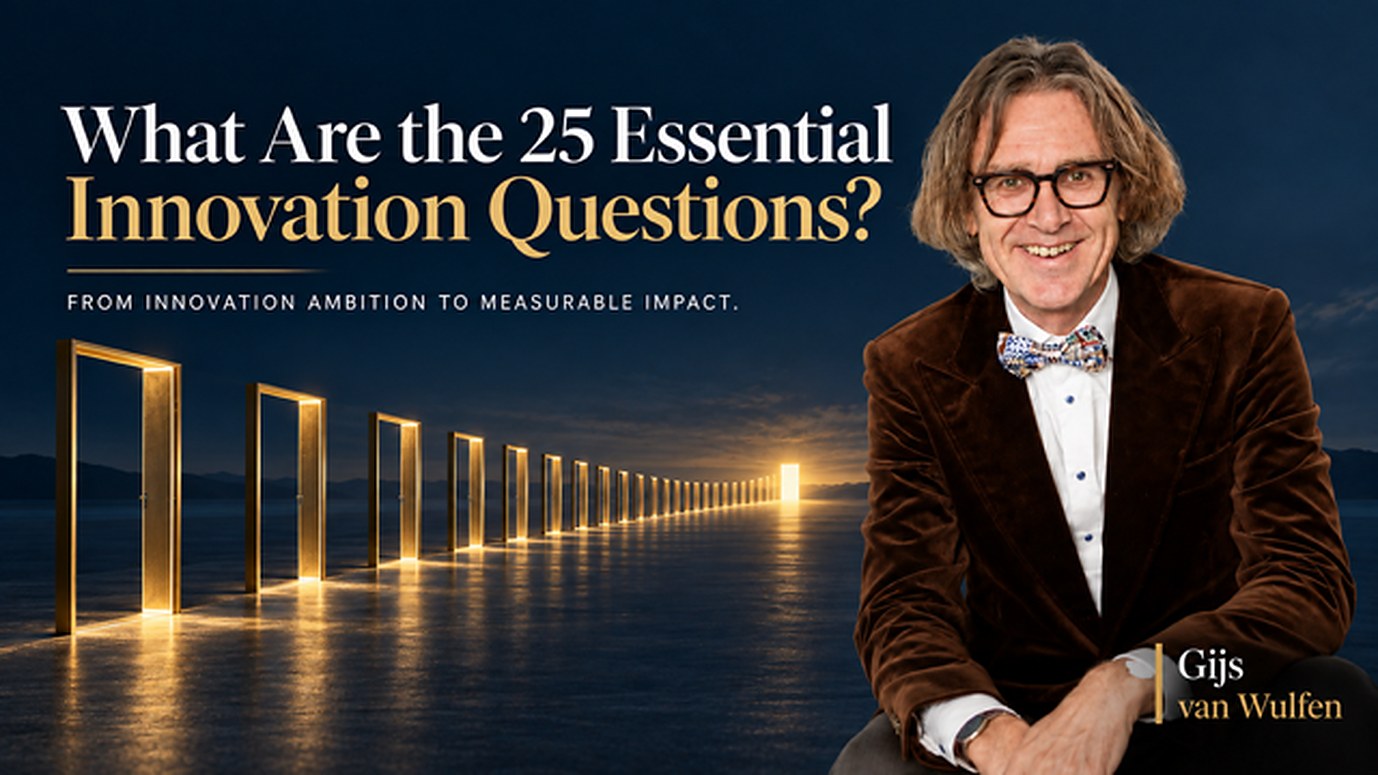
The 25 essential innovation questions are the questions leaders must answer to turn innovation ambition into customer value, organisational ownership and measurable impact.
By Gijs van Wulfen · 18 November 2026 · 43 min read
From innovation ambition to measurable impact. Visual: Gijs van Wulfen
Innovation rarely fails because organisations cannot generate ideas.
It fails because they do not answer the right questions together, in the right order, with the right people.
An organisation can organise an inspiring brainstorm, generate hundreds of ideas, build attractive prototypes and produce professional presentations without becoming more effective at innovation. Activity is visible. Progress is harder to recognise. Impact takes longer.
Because visible activity creates the reassuring impression that something is happening, organisations often continue moving without asking whether they are moving in a direction that matters.
After more than 25 years of leading innovation projects, I have learned that successful innovation is not driven by one brilliant answer. It is driven by a sequence of essential questions.
Each question reduces a different kind of uncertainty. Together, they connect strategy to customer relevance, creativity to evidence, and promising concepts to implementation.
These questions are not a checklist for an innovation manager to complete alone. They belong inside a shared organisational journey. Leaders, specialists, customers, partners and the people responsible for implementation must discover the answers together.
The quality of an innovation is limited by the quality of the journey that created it.
This article follows that journey from the first strategic discussion to the moment a new solution begins creating value. Along the way, it answers the 25 essential innovation questions every leader and innovation team must address.
The answers form one coherent story because that is how innovation works in practice. One answer changes the next question. One customer encounter exposes an assumption. One experiment redirects a concept. One leadership decision can accelerate—or quietly kill—the entire journey.
There is no shortcut around uncertainty.
There is, however, a much better way through it.
Stage one: Give innovation a strategic purpose
Innovation does not begin with an idea. It begins when leaders recognise that continuing along the present path may no longer be enough.
Sometimes the signal is obvious. Revenue is declining. A disruptive technology is changing the market. A new competitor is growing rapidly. Regulation is rewriting the rules. Customer behaviour is moving in an unfamiliar direction.
More often, the organisation is still successful. Customers remain loyal. Margins are acceptable. People are busy. That is precisely why the need to innovate is easy to postpone.
An organisation must innovate when its future ambition can no longer be achieved by optimising its present business alone.
That is the first essential innovation question because urgency gives innovation legitimacy.
Without genuine urgency, innovation becomes an optional side activity. People participate when their calendars allow it. Decision-makers delegate their role. Operational priorities repeatedly win. The initiative may produce enthusiasm, but it will not produce sustained commitment.
Urgency does not require panic. It requires honesty.
What is changing in customer behaviour, technology, society, regulation or the competitive landscape? Which growth ambition cannot be achieved through optimisation alone? What future opportunity might the organisation miss? Which current advantage is becoming less relevant? What position could be lost if nothing changes?
The Huntsman innovation story illustrates the importance of this question.
The company’s thermoplastic polyurethane business was healthy and had achieved strong growth. Yet much of its innovation consisted of product adaptations for individual customers. The existing innovation pipeline was unlikely to support the next level of ambition.
That created a meaningful strategic tension. Huntsman could continue improving what it already did, or transform how it innovated to pursue more radical opportunities.
The lesson is not that every successful company should immediately launch a radical innovation programme. The lesson is that innovation becomes serious when leaders can explain the gap between today’s trajectory and tomorrow’s ambition.
Urgency is the bridge between the two.
A methodology without urgency becomes an innovation hobby.
Urgency without a methodology becomes anxious activity.
Effective innovation requires both.
2. What is innovation?
Innovation is the creation and implementation of something new that delivers value.
This definition distinguishes innovation from creativity, invention and optimisation.
Creation without implementation remains an idea or invention. Implementation without meaningful newness is optimisation. Newness without value is novelty.
Innovation requires all three:
Something new must be created.
It must be implemented in practice.
It must produce meaningful value.
Organisations often use the word innovation to mean very different things. For one executive, innovation means digital transformation. For another, it means new products. A third expects cost reduction. A fourth wants a new business model. Employees may assume that innovation simply means being creative and proposing ideas.
When people begin with different definitions, they later disagree about priorities, resources, evidence and success.
A shared definition matters because it changes what the organisation celebrates.
If innovation means ideas, the company will count ideas.
If innovation means experiments, it will count prototypes and pilots.
If innovation means implemented value, it will still encourage ideas and experiments—but it will understand that they are intermediate steps.
Creativity builds the dream.
Innovation delivers the impact.
3. What strategic challenge should innovation address?
Innovation should address a strategically important customer problem, organisational challenge or future opportunity that is focused enough to guide exploration and open enough to permit surprising solutions.
“We need new ideas” is not an innovation assignment. It is an admission that direction is missing.
A useful innovation assignment identifies the arena in which the organisation wants to create value, the strategic reason for entering that arena and the boundaries within which people can explore.
If the assignment is too broad, the team wanders.
“Create the future of our company” sounds ambitious, but gives participants little practical direction.
If the assignment is too narrow, the answer has already been prescribed.
“Design a slightly cheaper version of our current product” may be a useful improvement challenge, but it leaves little room for innovation.
A strong innovation assignment creates productive tension. It is focused enough to guide people and open enough to surprise them.
It does not ask the team to confirm management’s preferred solution. It invites them to discover better possibilities.
The assignment should connect directly to strategic ambition. That is what attracts decision-makers. Their participation attracts strong people. Strong participation improves the quality of insights, ideas, decisions and ownership.
Effective innovation identifies a specific customer, user, employee, patient, citizen, partner or stakeholder whose progress matters.
“The customer” is not one homogeneous person.
Different customers have different goals, circumstances, behaviours, frustrations and definitions of value. Even within one market segment, the person buying a solution may not be the person using it. The person benefiting from it may not control the budget. The person blocking adoption may never appear in conventional market research.
Choosing for whom you want to create value is therefore a strategic decision.
A hospital does not simply buy equipment. Clinicians may want to make faster decisions with less cognitive burden. Patients may want reassurance, dignity and shorter waiting times. Administrators may seek capacity, reliability and lower costs.
A construction company does not simply buy building materials. It may seek greater design freedom, predictable delivery, lower labour dependency, reduced waste or a safer building process.
A traveller does not necessarily want a car, ticket or transport application. They want to arrive somewhere reliably, conveniently and affordably.
The moment innovators understand the progress people are trying to make, they stop defining opportunities through the products their organisation already sells.
That is the beginning of outside-in innovation.
5. What does innovation success look like?
Innovation success is the creation of meaningful value through a progression from strategic relevance and learning to implementation, adoption and impact.
At the beginning of an innovation journey, demanding a precise five-year financial forecast creates false certainty. Yet avoiding success criteria entirely creates drift.
The solution is to measure innovation effectiveness at five levels.
First comes relevance. Is the team addressing a strategically important opportunity and a meaningful customer friction?
Second comes learning. Has the team identified and reduced the uncertainties that could determine success or failure?
Third comes conversion. Are insights becoming ideas, ideas becoming concepts, concepts becoming supported business cases and business cases entering development?
Fourth comes adoption. Are customers, users and internal stakeholders changing their behaviour?
Fifth comes impact. Is the innovation creating commercial, operational, social or environmental value?
These levels prevent a common management mistake: measuring an early innovation concept as though it were already a mature business.
An early team should be accountable for disciplined learning, not for pretending that it can predict future revenue with conventional accuracy. As evidence grows and uncertainty falls, the investment criteria should become more demanding.
A prototype is not impact.
A pilot is not adoption.
A launch is not automatically success.
Innovation success occurs when something new is implemented and creates meaningful value in practice.
Stage two: Create ownership before asking for approval
When an innovation initiative becomes strategically important, organisations often create a small project team and position a steering committee above it.
The arrangement appears logical. The team does the work. Senior management periodically evaluates it.
Unfortunately, this often creates an ownership gap.
The project team interviews customers, explores trends, debates possibilities, rejects ideas, tests assumptions and improves concepts. The steering committee sees only a selection of slides during occasional meetings.
Months later, people who did not travel the road are asked to approve an unfamiliar destination.
Naturally, they ask critical questions.
Naturally, the team experiences those questions as resistance.
The people who must approve, develop, implement and support an innovation should help create it.
Ownership is not the same as approval.
Approval can be given during a management meeting. Ownership grows through participation, shared discovery and contribution.
People support what they help create.
I often compare an innovation journey with a family. The core innovation team are the parents of the emerging concepts. They live with them every day. They know where they came from, how they developed, what makes them promising and where they remain vulnerable.
The extended team and decision-makers are close relatives.
If those relatives meet the concepts only during a formal examination at the end, they may judge them severely. If they have watched the concepts grow, contributed insights, heard customer feedback and helped make difficult choices, they understand both their strengths and imperfections.
Innovation needs critical thinking.
It does not need distant judgement.
The people who will later carry responsibility must not be treated as an audience. They should become participants in the creation of the answer.
7. How should decision-makers participate in innovation?
Decision-makers should participate at the moments when strategic meaning, customer understanding, major choices and organisational commitment are created.
Senior leaders do not need to attend every working session. They do need to be present during the full kickoff, the sharing of customer and trend discoveries, the central ideation sessions, concept evaluation and the final business-case decision.
In a 15-week FORTH innovation journey, this can require approximately seven and a half days from key decision-makers.
That is a serious commitment.
It is also one of the reasons the methodology works.
Leadership participation signals that the assignment matters. It attracts capable participants. It accelerates decisions. It lets leaders encounter customer evidence directly. It allows concerns to be discussed before they harden into opposition.
Most importantly, it transforms decision-makers from judges into co-creators.
At CCI, a Dutch confectionery company, the innovation journey began near the end of the COVID-19 pandemic and adopted a hybrid format. A few weeks into the journey, the company’s factory hall burned down.
Management suddenly faced a crisis far more immediate than innovation. Yet the journey continued.
Rebuilding the factory could now take future production requirements emerging from the innovation journey into account. Shareholders and members of the Supervisory Board participated at crucial moments. Their support developed through involvement, not through a final presentation.
When decision-makers join the expedition, they do not need to be persuaded afterwards that the journey was worthwhile. They experienced why it mattered.
8. Who should be on an innovation team?
An innovation team should combine the people needed to understand customers, create unconventional possibilities, test feasibility, develop a business model and implement the outcome.
Innovation is too important to leave only to innovators.
A strong team brings together people from different functions, levels, backgrounds and ways of thinking. It includes customer knowledge, technological expertise, operational experience, commercial understanding and organisational influence.
It needs imaginative minds and practical minds.
It needs challengers and connectors.
It needs specialists and generalists.
Diversity is not decoration. It expands what a team can notice and reduces the chance that everybody shares the same blind spots.
Homogeneous teams may reach agreement quickly because their members interpret the world in similar ways. Innovation teams need enough difference to create productive friction and enough trust to use that friction constructively.
In the NTT DATA and Honda innovation case in Japan, half of the core team came from each organisation. NTT DATA did not leave, create a consultancy answer and return with a presentation. People from both organisations explored and created together.
That changed the conventional client-supplier relationship.
Business knowledge, technological insight, customer understanding and responsibility for the future met inside one shared process.
Facilitate innovation with the business—not for the business.
9. How much time should people receive for innovation?
Participants need protected working time, a fixed innovation rhythm and explicit permission to reduce competing responsibilities.
Innovation cannot be an important priority that must always wait for more urgent work.
If participants are expected to innovate on top of a completely occupied job, operational activities will usually win. This is not necessarily because people lack courage or motivation. Today’s work has deadlines, customers and immediate consequences. Tomorrow’s opportunity remains uncertain.
Time allocation is therefore a test of leadership sincerity.
Is the organisation willing to clear calendars, adjust expectations and protect the rhythm of the journey?
When participants repeatedly miss sessions, continuity disappears. They no longer share the same discoveries. Decisions must be explained again. Trust develops unevenly. Energy leaks away. A process designed to build momentum turns into a series of restarts.
A recurring schedule creates more than efficiency. It gives innovation a legitimate place inside the organisation.
If leaders say innovation matters but refuse to release people from existing responsibilities, the organisation has already answered the real question.
Operations still matters more.
10. How do leaders create psychological safety for innovation?
Leaders create psychological safety by making it acceptable to express uncertainty, challenge assumptions, share unfinished ideas and report disappointing evidence without personal punishment.
Innovation begins where knowledge ends.
If employees are expected to appear certain, they will hide their doubts.
If unusual ideas provoke ridicule, people will offer conventional ones.
If experiments are judged only by whether the original hypothesis was correct, teams will manipulate evidence or avoid ambitious assumptions.
Psychological safety does not mean avoiding standards, accountability or uncomfortable debate. It means making it possible to speak honestly.
People must be able to ask naïve questions, challenge senior opinions, expose uncertainty and say that a preferred concept is not working.
The work can be criticised. The person must remain respected.
Creative trust grows when judgement is postponed during divergence. Internal trust grows when functions share unfinished knowledge. Leadership trust grows when managers respond to bad news with curiosity before consequence.
Together, these forms of trust make the truth discussable.
Innovation depends on the truth becoming discussable early—while changing direction is still relatively inexpensive.
Stage three: Discover the opportunity before developing the solution
Once the assignment and team are in place, enthusiasm often pushes people directly towards solutions.
Participants know the organisation. They understand the industry. They have years of experience. Surely it would be efficient to use that knowledge and start generating ideas.
Experience is valuable.
But experience also has a shadow: it makes assumptions feel like facts.
11. What do we know—and what are we assuming?
Innovation teams must distinguish evidence from experience, opinion, organisational habit and untested belief.
At the beginning of the journey, write down what the team believes about customers, competitors, technology, regulation, market behaviour and internal capabilities.
Then ask:
What evidence supports this?
How recent is that evidence?
Did we observe it directly?
Does it apply to all customers or only to a familiar group?
What would we discover if the opposite were true?
Teams frequently find that their most consequential claims are based on anecdotes, old research, second-hand sales reports or internal agreement.
Consensus is not customer evidence.
Assumptions are unavoidable in innovation. The problem is not having assumptions. The problem is forgetting that they are assumptions.
Making them visible transforms uncertainty from a vague source of anxiety into a set of questions the team can investigate.
12. What are customers trying to achieve?
Customers are trying to make progress in a specific situation; innovators must understand that desired progress before designing a solution.
Customers do not wake up wanting your product category.
They want to complete a task, overcome a difficulty, avoid a risk, gain confidence, save effort, create status, experience pleasure or reach a meaningful goal.
Understanding customer goals changes the innovation frame. It shifts attention from the thing the organisation currently sells to the progress a person is seeking.
Do not begin by presenting an idea and asking whether somebody likes it. Start by entering the customer’s world.
Who are they?
What do they do?
What are the requirements and goals of their work or life?
How do they currently achieve those goals?
What does excellent performance look like?
Which compromises have they accepted?
The quality of these conversations determines whether the organisation discovers something meaningful or merely confirms what it already believes.
13. What are customer frictions?
Customer frictions are the difficulties, delays, risks, uncertainties, inconveniences and recurring disappointments people experience while trying to reach their goals.
Customer friction is the raw material of relevant innovation.
A friction may be visible, such as waiting time, excessive cost or a process failure. It may also be emotional or social: fear of making a mistake, lack of confidence, loss of control, embarrassment or the difficulty of persuading another stakeholder.
Strong customer conversations move gradually towards this core.
Begin with who people are and what they do. Understand their goals and requirements. Ask about best practices and challenges. Then explore what is difficult to accomplish and why.
Ask for recent examples.
Notice workarounds.
Observe contradictions between what people say and what they do.
Look for tasks they have accepted as inevitably difficult.
Avoid asking customers to design the solution for you. Customers are experts in their experiences, goals and problems. Innovators must translate those discoveries into possibilities customers may not yet be able to imagine.
A company that begins with its technology asks:
“Where can we sell this?”
A company that begins with customer friction asks:
“What meaningful progress can we enable?”
The second question creates a much larger innovation space.
14. Which trends and technologies could change the customer’s world?
Relevant trends and technologies are external developments capable of changing customer behaviour, expectations, costs, capabilities or power.
Trend exploration should not become a collection of fashionable labels.
Artificial intelligence, demographic change, energy transition, new regulation, urbanisation and digital platforms matter only when the team translates them into consequences.
What new behaviour becomes possible?
Which cost is falling?
Which capability is becoming widely available?
What is becoming scarce?
Which expectation is rising?
What is becoming unacceptable?
Who gains power?
Who risks becoming irrelevant?
Trend exploration helps a team distinguish a temporary difficulty from a structural opportunity.
It also prevents innovation from being trapped in today’s customer vocabulary. Customers understand their present reality extremely well, but they may not know how an emerging technology, regulatory development or business model could transform it.
Innovators must connect three worlds:
What customers are trying to achieve.
What currently makes that difficult.
What external change could make a new answer possible.
That intersection is fertile ground for innovation.
15. Which innovation opportunities should we pursue?
Organisations should pursue opportunity areas that combine meaningful customer relevance, important external change, strategic importance and a credible right to participate.
Not every customer friction should become your innovation challenge.
Some frictions are too small. Some are already solved effectively. Some fall outside the organisation’s strategic ambition. Others require capabilities or investments that would never be realistic.
The strongest opportunity areas sit at the intersection of four elements:
A meaningful and persistent customer friction.
An external development that makes a new response possible or necessary.
Strategic relevance for the organisation.
A credible combination of capabilities, relationships, purpose or ambition.
Strategic fit does not mean selecting only opportunities close to the current business.
Sometimes the reason to pursue an opportunity is precisely that it helps the organisation develop the position and capabilities it will need tomorrow.
The question is not only:
“Can we do this today?”
It is also:
“Would pursuing this help us become the organisation we need to be tomorrow?”
This is the purpose of Observe & Learn, the second stage of the FORTH Innovation Methodology. Teams explore customers, frictions, technology, trends and inspiring practices before creating concepts.
That discipline may feel slower than jumping directly to solutions.
In practice, it prevents organisations from spending months efficiently developing the wrong answer.
Stage four: Create choices before making choices
Teams return from the outside world carrying more than information.
They bring back customer stories, surprises, tensions, contradictions and new questions. The innovation assignment is no longer an abstract sentence on a slide. It has become tangible.
This is the right moment to create ideas.
Not because creativity follows research mechanically, but because insight gives imagination something meaningful to work on.
16. How do we turn customer insights into innovative ideas?
Innovation teams turn insights into ideas by converting important customer frictions, external developments and inspiring practices into focused creative questions.
A friction such as “maintenance teams lose hours waiting for specialist diagnosis” might become:
“How might we help a general technician identify the cause safely within minutes?”
A technological development such as distributed intelligence might become:
“How might we bring decision support directly to the place where the work happens?”
An inspiring practice from another sector might create the question:
“How might we bring the transparency of parcel tracking into an industrial service process?”
The wording matters.
A strong creative question points towards customer value without prescribing the solution.
It opens a field.
A weak creative question contains the organisation’s preferred answer and merely asks participants to decorate it.
Good ideation questions connect imagination to relevance. They give creativity a meaningful target while preserving enough freedom for unexpected combinations.
17. How many ideas should an innovation team generate?
An innovation team should generate enough variety to move beyond familiar answers before selecting and developing the strongest directions.
There is no universal ideal number of ideas.
The important principle is that the first ideas are rarely the most original. They usually reflect solutions people already know, previous proposals or variations of the organisation’s current offering.
If a team begins selecting from this shallow pool, familiarity wins.
More radical possibilities tend to emerge after the obvious answers have been exhausted and different perspectives begin interacting.
Quantity is therefore not the goal. It is a route towards variety.
In one Breman innovation journey, the process moved from 173 customer frictions to 1,191 ideas. These were clustered and reduced to 67 idea directions, which became 18 concepts. Sixteen concepts were tested. Twelve were improved. Six business cases were developed, and three initiatives were selected.
These numbers are not a formula for every organisation. They reveal the shape of disciplined innovation:
Open widely.
Combine intelligently.
Narrow deliberately.
Increase the quality of evidence at every step.
Premature selection feels efficient because it reduces the workload.
It also reduces the possibility of surprise.
18. How should innovation teams select and combine ideas?
Innovation teams should combine complementary insights into coherent concepts and evaluate them against explicit criteria rather than merely voting for favourite ideas.
A popular idea is not automatically a promising opportunity.
People tend to vote for ideas they understand, ideas close to their expertise or ideas presented by influential colleagues. The most familiar proposal can therefore win before the most original combination has had time to develop.
The strongest concept may combine a customer insight identified by sales, a technological possibility introduced by R&D, an operational model suggested by supply chain and a revenue logic contributed by finance.
No single person arrived with the complete answer.
This is WE-nnovation: innovation as a collective act.
The team does not compete to prove whose idea wins. It builds stronger propositions from partial contributions.
A concept is more than a sentence on a sticky note. It identifies:
The target group.
The customer friction or aspiration.
The proposed solution.
The distinctive benefit.
How the solution works.
Why it could create value.
Which important assumptions remain.
Giving an idea this coherent first form makes meaningful discussion and testing possible.
19. What role should artificial intelligence play in innovation?
AI should accelerate research, pattern recognition, idea generation, prototyping and analysis while people retain responsibility for customer understanding, strategic decisions, trust and implementation.
AI can analyse enormous volumes of information. It can identify patterns, stimulate unexpected associations, generate alternatives, create visualisations, challenge omissions and accelerate concept development.
Used wisely, AI increases an innovation team’s reach and reduces the cost of iteration.
But speed creates a new danger.
A system may produce 500 ideas, ten concepts, convincing images and a business-case narrative in hours. The organisation receives polished answers that nobody has earned the confidence to believe.
Output begins to resemble progress.
It is not the same.
AI can propose.
People must understand.
AI can simulate customer responses.
Real customers must still react.
AI can draft a business case.
Decision-makers must still understand and own its assumptions.
AI can help the team travel faster, but it cannot replace the shared experiences through which strategic trust, customer trust, creative trust, market trust and implementation ownership develop.
Imagine an AI system producing an entire innovation proposal in one day. It analyses the market, identifies frictions, creates concepts, calculates financial scenarios and prepares a beautiful presentation.
Then somebody in the boardroom asks:
“Why should we believe this?”
Who met the customers?
Who witnessed the frustration?
Who challenged the strategic assumptions?
Who experienced the disagreement?
Who saw the first concept fail?
Who changed their mind because of new evidence?
Who is willing to put their reputation behind the outcome?
Innovation is not only the creation of a new solution. It is also the creation of collective conviction around that solution.
The faster innovation becomes technologically, the more important the human innovation journey becomes organisationally.
Stage five: Turn assumptions into evidence
At the concept stage, teams often fall in love.
They have invested imagination, time and reputation. The concept feels like their creation. Its weaknesses can feel like criticism of its creators.
That reaction is understandable.
It is also dangerous.
The purpose of testing is not to prove that the team was right. It is to discover what must change while changing it remains relatively inexpensive.
20. Which assumptions must be true for an innovation to succeed?
Every innovation team should identify and prioritise the customer, technical, operational, commercial and organisational assumptions on which its concept depends.
Customers must experience the friction strongly enough.
The proposed benefit must matter.
The solution must fit existing behaviour or offer enough value to justify changing it.
The technology must perform reliably.
Operations must be able to deliver.
Regulation must permit it.
Partners must cooperate.
The economics must eventually work.
The organisation must possess or acquire the required capabilities.
A concept can appear attractive while one hidden assumption makes the entire proposition impossible.
Listing assumptions transforms vague uncertainty into testable questions.
Rank them according to two dimensions:
How important is this assumption to the concept’s success?
How uncertain are we that it is true?
An assumption that is both critical and uncertain deserves attention before the team perfects less important details.
Do not begin by testing what is easiest.
Begin by testing what could make the concept irrelevant.
21. What is the fastest credible innovation experiment?
The fastest credible experiment is the smallest test capable of producing trustworthy evidence for an important innovation decision.
“Fastest” and “credible” belong together.
A quick but unconvincing experiment creates misleading confidence. A perfect but excessively slow experiment consumes resources before the concept has earned them.
The correct experiment depends on the assumption.
Customer desirability may require concept interviews, observation, behavioural tests, pre-orders or evidence of willingness to invest time.
Technical feasibility may require a prototype or technical trial.
Operational feasibility may require a process simulation.
Commercial viability may require willingness-to-pay evidence, conversations with channels or cost modelling.
The purpose of an experiment is not theatre. It is not a demonstration organised to make management enthusiastic.
It is a deliberate attempt to reduce uncertainty.
Before conducting the experiment, define:
Which assumption is being tested?
What evidence will be collected?
What outcome would strengthen confidence?
What outcome would weaken it?
What decision could change as a result?
Experiments create value when they influence decisions.
22. How should innovative concepts be tested with customers?
Innovative concepts should be presented consistently to relevant customers and evaluated for relevance, distinctiveness, credibility, fit and likelihood of adoption.
Concept testing is not a sales presentation.
The objective is not to make respondents applaud. It is to learn which aspects resonate, confuse, repel or fail to matter.
Present each concept clearly and consistently. Ask respondents for an overall assessment, but do not stop at a numerical score. Explore the reasoning behind it.
What attracts them?
Which friction does it solve?
What is unclear?
What would prevent adoption?
How does it compare with their current solution?
What would make it more valuable?
Ask for a top and a tip: the strongest element and the most important improvement.
Listen especially carefully to the explanation behind the score. The number indicates direction. The explanation creates learning.
Compare responses across participants. Look for repeated patterns, meaningful differences between customer groups and objections the internal team did not anticipate.
Also distinguish politeness from commitment.
People may say that they like a concept because they want to be helpful. Behaviour creates stronger evidence. Are they willing to share data, introduce another decision-maker, participate in a pilot, invest time, sign a letter of intent or pay?
Do not ask only:
“Do customers like it?”
Ask:
“What did customers do that demonstrates this matters?”
23. When should an innovation concept be improved, pivoted or stopped?
A concept should be improved when its central value remains credible, pivoted when evidence points towards a stronger direction, and stopped when a critical assumption repeatedly fails.
Testing is useful only when it changes something.
Many teams collect feedback and then defend their original concept. They explain that customers misunderstood it. They dismiss inconvenient comments as exceptions. They improve the presentation instead of improving the proposition.
Real learning requires the willingness to be wrong.
Most concepts should be improved after customer testing. Very low-scoring or fundamentally flawed concepts may need to stop. Others reveal an unexpected customer group, application or value proposition and should pivot.
Stopping is not automatically failure.
If innovation explores genuine uncertainty, some concepts must stop. A portfolio in which everything succeeds may contain very little innovation—or very weak evidence standards.
Stopping becomes a sign of discipline when the team agreed beforehand which assumption was being tested, conducted a credible experiment and documented the learning.
There is also an important difference between perseverance and attachment.
Perseverance means remaining committed to creating value while adapting the route.
Attachment means defending one particular solution despite the evidence.
Innovators need perseverance.
They must guard against attachment.
Stage six: Bring supported opportunities home
Many innovation approaches end with an idea, prototype or validated concept.
Organisations do not implement concepts automatically. They implement decisions. They allocate people and money. They change systems. They accept risk. They overcome resistance. They persist through operational difficulty.
The homecoming is therefore not the ceremonial end of innovation.
It is the moment an opportunity must earn the right to enter its next, more demanding stage.
24. What belongs in an innovation business case?
An innovation business case should connect strategic relevance, customer evidence, the concept, market potential, feasibility, viability, risks, capabilities, investment, roadmap and ownership.
A mini new business case should be substantial enough to support a decision and honest enough to show what remains unknown.
It should explain:
Why this opportunity matters strategically.
Which customer group is being served.
Which friction or aspiration the concept addresses.
How the concept creates distinctive value.
What customers and other stakeholders said or did.
Which external developments support the opportunity.
How the solution might work technically and operationally.
What business model could make it viable.
Which assumptions and risks remain.
Which capabilities and partners are required.
What the next experiment or development milestone should be.
How much investment is needed for the next stage.
Who will own and lead the initiative.
The word “mini” matters.
At the front end of innovation, the business case must not pretend to eliminate uncertainty. A spreadsheet that extends uncertain assumptions to two decimal places is not rigorous. It is theatre.
Good innovation governance matches the precision of the decision to the maturity of the evidence.
FORTH normally brings home a small portfolio of supported mini new business cases rather than one supposed winner. Early markets remain uncertain. A portfolio preserves options and allows leaders to balance different time horizons, strategic themes, capability needs and risk levels.
The homecoming is not a pitch competition.
It is the moment the expedition returns with opportunities shaped by strategy, customers, creativity, evidence and collective judgement.
Because decision-makers participated in the journey, the final conversation can focus on commitment and next steps instead of reconstructing months of context.
25. How do organisations move from innovation concept to implementation?
An organisation moves from concept to implementation by appointing an accountable owner, protecting a capable team, providing staged resources and defining the next evidence-based milestones before the front end ends.
This is the question that separates innovation from innovation theatre.
An approved business case without an owner, team, budget and next milestone is only an approved document.
The applause following the final presentation can create a dangerous illusion of completion.
In reality, the hardest part may be beginning.
Implementation needs a named entrepreneurial owner with sufficient authority. It requires a cross-functional team because the work will cross functions. It needs staged funding connected to learning and delivery milestones. It requires leaders willing to protect a fragile initiative from the operational antibodies of the existing organisation.
The transition to development should be designed before the final meeting.
Which development process will receive the concept?
When will the next investment decision take place?
Innovation also needs continuity of understanding.
If a new implementation team receives only the final presentation, much of the journey’s intelligence disappears. They see the answer but not the customer encounters, alternatives, rejected assumptions or reasons behind important choices.
A strong handover transfers evidence, relationships, experience and ownership—not merely documents.
The handover should feel less like throwing a package over a wall and more like transferring responsibility during the same expedition.
Four innovation cases that connect the questions
The 25 questions are not separate management techniques. They form one system.
Four cases—Huntsman, CCI, Bruil and NTT DATA with Honda—show how different parts of that system interact in practice.
Huntsman: strategic urgency comes before methodology
At Huntsman, FORTH was attractive because it transformed the fuzzy front end of innovation into understandable stages. It combined creativity with business thinking and produced tangible outcomes during the journey.
But the methodology became relevant only when the organisation recognised a genuine strategic challenge. Incremental product adaptations were unlikely to support its growth ambition.
This is an important warning for innovation professionals.
Do not begin by selling a process.
Begin by helping leaders understand the future gap the process must address.
The Huntsman case connects several essential questions: Why must we innovate now? Which strategic challenge must we address? Who should participate? What kind of innovation will be required to achieve our ambition?
When those answers align, methodology becomes a route towards a meaningful destination.
Without alignment, it becomes another corporate initiative competing for attention.
CCI: ownership protects innovation under pressure
CCI’s innovation journey was tested by two extraordinary circumstances: the COVID-19 pandemic and a devastating factory fire.
Either event could have justified postponement. Together, they could easily have ended the programme.
Management chose to continue.
The journey had become connected to the company’s strategic future. The reconstruction of the factory could incorporate production implications emerging from new ideas. Shareholders and Supervisory Board members participated in crucial parts of the innovation process.
They were not presented with a surprising conclusion at the end. They experienced how the concepts developed.
Ownership is sometimes dismissed as a soft cultural factor.
It is operational infrastructure.
When adversity appears, ownership determines whether innovation is protected or abandoned. It cannot be added to the final presentation. It must be built during the journey.
Bruil: a prototype is only the beginning
Bruil’s development of 3D-printed concrete demonstrates the enormous distance between proving a technology and producing impact at scale.
The original mini new business case described possibilities that later became remarkably concrete. More than 700 3D-printed concrete elements were needed for the renovation of a 70-home apartment building in Den Helder. This opportunity contributed to the creation of a first production location and Bruil Prefab Printing.
Yet scaling the production system proved more difficult than demonstrating the technology.
The factory, digital production process, reliability, investment, partners and launching customers all had to come together. Trial and error continued long after the first technical success.
A prototype asks:
“Can this work?”
A scalable operation asks:
“Can we deliver this reliably, repeatedly and economically in the real world?”
The second question is usually much harder.
Bruil also demonstrates the importance of a launching customer. Customers do more than validate a concept. The right customer can become a partner in making an entirely new operation possible.
Innovation discipline is not only the courage to begin.
It is the perseverance to move from possibility to impact.
NTT DATA and Honda: co-creation builds capability
NTT DATA wanted to evolve from an IT-services provider responding to customer requirements into an innovation partner.
Together with Honda, it explored new business models connected to the expected growth of electric vehicles. Future mobility behaviour, ecosystems and viable revenue models were uncertain. FORTH, combined with NTT DATA’s Business Design Sprint, made this ambiguity manageable.
The organisation of the work was significant.
Participants from NTT DATA and Honda created the concepts together. NTT DATA contributed facilitation and consultancy expertise without removing ownership from Honda.
The process combined structure, customer exploration, creative thinking, hypothesis development and business grounding.
The concepts were reported as still being developed, so the case should not be presented as completed commercial impact. Its value lies elsewhere: promising concepts were developed, cross-company collaboration strengthened, management support grew and innovation capability became transferable.
NTT DATA trained facilitators and shared lessons from different projects. This reduced dependence on one gifted individual and helped innovation become repeatable.
A sustainable innovation capability is not created by an innovation department that invents on behalf of everybody else.
It is created when people throughout the organisation learn how to innovate together.
Why the order of the 25 innovation questions matters
The questions follow a deliberate logic.
Strategy determines where to explore.
Team design determines who will learn and own.
Observation determines which problems deserve creativity.
Divergence creates options.
Testing transforms assumptions into evidence.
Business cases transform evidence into investment choices.
Implementation transforms choices into impact.
Reverse the order and familiar problems appear.
Generate ideas before defining the challenge, and creativity scatters.
Define the challenge without understanding customers, and internal assumptions dominate.
Select concepts before creating variety, and familiar ideas win.
Develop business cases before testing concepts, and financial projections disguise uncertainty.
Ask leaders for approval after excluding them from the journey, and resistance appears.
Celebrate approval without implementation ownership, and the work disappears into a drawer.
This is why innovation needs structure.
Structure does not mean bureaucracy. It means arranging questions, people, evidence and decisions so that one stage earns the next.
Uncertainty needs structure, while creativity needs freedom.
Within each stage, teams need freedom to explore.
Between stages, they need clear deliverables, choices and commitments.
This combination protects creativity from chaos and protects the organisation from endless exploration.
How FORTH turns 25 questions into one innovation journey
The FORTH Innovation Methodology organises the fuzzy front end into five stages travelled over approximately 15 weeks.
Full Steam Ahead
Full Steam Ahead establishes urgency, the innovation assignment, the team, decision-maker commitment and the expedition plan.
It answers why the organisation must innovate, which challenge it will address, who must participate and how success will be recognised.
This stage creates strategic trust.
Observe & Learn
Observe & Learn moves from inside-out assumptions to outside-in discovery.
The team explores customers, customer frictions, technologies, trends, inspiring practices and the organisation’s own relevant capabilities.
This stage builds customer trust and identifies opportunity areas worth pursuing.
Raise Ideas
Raise Ideas converts discoveries into creative questions, generates a wide variety of ideas and develops the strongest combinations into concrete concepts.
It gives creativity freedom within a meaningful strategic frame.
This stage builds creative trust.
Test Ideas
Test Ideas brings the concepts into the outside world.
Customers and other relevant stakeholders evaluate them. Teams learn, improve, pivot or stop. External evidence begins replacing internal enthusiasm.
This stage builds market trust.
Homecoming
Homecoming translates improved concepts into supported mini new business cases, roadmaps and investment decisions.
The journey returns with a portfolio that decision-makers understand because they helped create it.
This stage builds leadership and implementation trust.
The expedition metaphor is deliberate.
An expedition has a destination and a planned route, but it expects surprise. People travel together. They encounter realities no map could fully predict. They return changed by what they experienced.
FORTH does not guarantee that every concept will succeed. No honest innovation methodology can.
It improves the conditions under which organisations identify relevant opportunities, create original solutions, build evidence, develop ownership and move towards implementation.
The deeper result is not only the portfolio produced.
Participants learn to tolerate uncertainty, observe before solving, separate divergence from convergence, test assumptions and collaborate across organisational boundaries.
Decision-makers learn to support innovation without controlling it prematurely.
The organisation becomes better prepared for its next innovation journey.
How should organisations measure innovation effectiveness?
Innovation effectiveness should be measured through relevance, learning, conversion, adoption and impact—not through activity alone.
Relevance
Are innovation teams addressing strategically important opportunities and meaningful customer frictions?
A beautifully executed concept in an irrelevant field is still a poor investment.
Learning
Are teams identifying and reducing critical uncertainties?
A disproved assumption can represent valuable progress when it prevents a much larger bad investment.
Conversion
Are relevant opportunities moving from insights to ideas, concepts, customer tests, business cases and development?
The objective is not to maximise the survival rate. It is to help the most promising opportunities progress while stopping weak ones responsibly.
Adoption
Are customers, users and internal stakeholders changing their behaviour?
A launch is a company event.
Adoption is a customer event.
Impact
Is the innovation creating its intended commercial, operational, environmental or social value?
Patents, ideas, prototypes and pilots are indicators of activity or progress. They are not final proof of innovation impact.
Together, these five measures create a more honest innovation dashboard. They respect the maturity of each opportunity while keeping attention on the ultimate objective: meaningful value in practice.
Why better innovation questions create economic value
Fifteen weeks sounds slower than a two-day sprint. Customer visits, decision-maker participation and repeated concept tests appear more expensive than commissioning a report or asking AI to generate solutions.
That comparison considers only the cost of the front end.
The larger economic question is what happens afterwards.
A weakly grounded concept can consume months of development, management attention, technological investment and commercial preparation before the company discovers that customers do not care.
A project without cross-functional ownership may remain stuck in queues and approval processes.
A solution built around an untested operational assumption can require expensive correction close to launch.
A successful pilot without a scaling model may remain trapped permanently between demonstration and business.
The purpose of a strong innovation front end is not to predict everything.
It is to discover the most expensive mistakes while they are still relatively cheap.
Customer discovery reduces relevance risk.
Diverse participation reduces organisational blind spots.
Implementation planning reduces transfer and scaling risk.
Seen this way, time invested in the front end is not an administrative burden.
It is risk reduction through organised learning.
Speed should be measured from ambition to impact—not from assignment to first idea.
How innovation journeys change organisational culture
Leaders often ask how to build an innovation culture.
The discussion usually turns towards values, training, campaigns and creative working environments. These can contribute, but culture is shaped most powerfully by repeated experience and visible consequences.
People observe what happens when somebody challenges an established assumption.
They remember whether leaders participated.
They notice whether customer evidence changes a senior manager’s opinion.
They see whether operational managers release strong employees or protect departmental capacity.
They learn whether disappointing experiments produce punishment, curiosity or silence.
They watch whether approved concepts receive real resources.
Every innovation journey teaches the organisation what innovation actually means there.
If leaders speak about boldness but fund only predictable extensions, the cultural lesson is caution.
If brainstorms are celebrated but implementation is neglected, the lesson is performance without consequence.
If external consultants create every concept, the lesson is dependency.
If teams can learn honestly and supported concepts progress, the lesson is that innovation is serious work.
A trained innovation facilitator plays an important role in this process. Facilitation is not limited to running creative exercises.
The facilitator helps leaders formulate a meaningful assignment, creates a diverse team, protects psychological safety, separates divergence from convergence, makes assumptions visible, organises customer learning and connects decisions to evidence.
The facilitator owns the journey—not the answers.
As more people participate in well-designed innovation journeys, a shared language develops.
“What is the customer friction?” replaces vague discussion about needs.
“What must be true?” makes assumptions discussable.
“What evidence would change our decision?” improves experimentation.
“Who owns the next step?” prevents inspiring endings without action.
Culture changes when these questions move from the innovation workshop into everyday management.
From innovation questions to innovation capability
At first sight, the 25 essential innovation questions appear to concern separate subjects: strategy, customers, teams, creativity, AI, experimentation, finance and implementation.
In practice, they form one system.
An organisation becomes effective at innovation when it can repeatedly move through this system without losing relevance, momentum or ownership.
It learns to create urgency without panic.
Focus without suffocating creativity.
Diversity without fragmentation.
Speed without superficiality.
Evidence without false certainty.
Governance without bureaucracy.
This capability is not located inside one innovation department. It is distributed among leaders, facilitators, specialists, customers and operational owners.
Innovation professionals should therefore resist the temptation to become the permanent creators of everybody else’s innovations.
Their most scalable contribution is to design and facilitate journeys in which the business creates, tests and owns its future.
That is why I use the term WE-nnovation.
The mythology of innovation celebrates the lone genius.
Organisational innovation is almost always collective.
One person may have an insight, but transforming it into impact requires expertise, access, trust, investment, production, sales, service and perseverance.
The central challenge is not simply finding a brilliant mind.
It is helping many minds make a meaningful journey together.
A final reflection for innovation leaders
If your organisation says it wants innovation, look beyond visible activity.
Do not ask only how many ideas were generated.
Ask whether the strategic challenge mattered.
Do not ask only whether the workshop was inspiring.
Ask what customers taught the team.
Do not ask only whether the prototype worked.
Ask which critical uncertainty it reduced.
Do not ask only whether management approved the business case.
Ask whether management helped create the conviction behind it.
Do not ask only whether something launched.
Ask whether people adopted it and whether it created value.
Innovation effectiveness is an organisation’s repeatable ability to transform strategically relevant opportunities into implemented solutions that create meaningful value.
It is not achieved by asking these 25 questions once.
It is built by making them part of how the organisation moves from uncertainty to impact.
The answers will differ by sector, culture, technology and moment. The journey will contain surprises. Concepts will change. Some will stop. Plans will meet reality.
That is not evidence that innovation has failed.
It is evidence that innovation is doing its real work: replacing assumptions with learning before the organisation makes its largest commitments.
Bring the right people together.
Give them a challenge that matters.
Enter the customer’s world.
Create more possibilities than feel comfortable.
Test what must be true.
Improve what deserves to continue.
Bring home opportunities that leaders understand and own.
Then give committed people the mandate and resources to turn promise into impact.
That is how 25 essential innovation questions become one coherent innovation journey.
That is how innovation ambition becomes innovation effectiveness.
Key takeaways
Innovation starts with strategic urgency—not with ideas.
Innovation is something new that is implemented and creates meaningful value.
A clear innovation assignment focuses creativity without prescribing the answer.
Customer friction is the raw material of relevant innovation.
Decision-makers should join the journey instead of judging it from the shore.
Diversity expands possibilities; trust makes diversity productive.
AI accelerates innovation output, but human participation builds conviction and ownership.
Experiments should reduce the most important uncertainties first.
A prototype proves possibility—not scalable impact.
A strong innovation business case combines evidence with honesty about uncertainty.
Innovation succeeds only when somebody owns implementation.
Innovation effectiveness should be measured through relevance, learning, conversion, adoption and impact.
The objective is not innovation activity. The objective is meaningful value in practice.
Want to improve your organisation's innovation effectiveness?
Discover how the FORTH Innovation Methodology helps leaders and multidisciplinary teams transform strategically relevant customer frictions into tested concepts and supported mini new business cases.
For more than 25 years, he has helped organisations transform innovation ambition into customer-centred concepts, supported business cases and real impact.
FORTH is a structured, outside-in and participative innovation methodology used by organisations around the world and supported by an international community of certified facilitators.