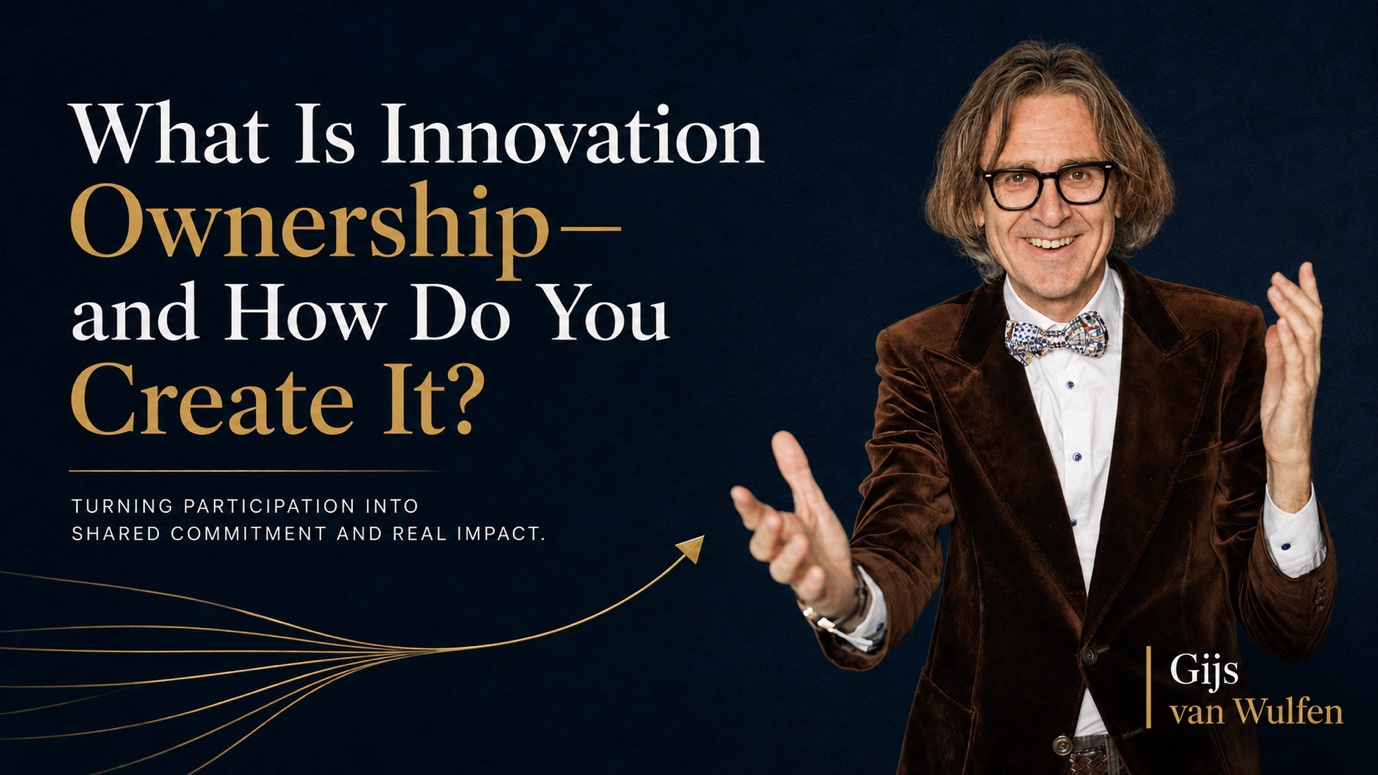
What Is Innovation Ownership—and How Do You Create It?
Innovation ownership is the shared rational and emotional commitment that gives people the responsibility, energy and perseverance to transform an innovative concept into real impact.
By Gijs van Wulfen · 7 October 2026 · 25 min read
Innovation does not fail only because organisations lack ideas. It also fails because too few people feel responsible for making those ideas real.
A small innovation team develops a promising concept. Senior leaders see it for the first time during a steering-committee presentation. Production is asked whether it can manufacture it. Sales is told to sell it. Operations receives an implementation plan. Everyone is involved—but nobody truly owns it. The language exposes the problem:
“That is their innovation project.”
Real progress begins when the language changes:
“This is our innovation, and we are going to make it work.”
That change is innovation ownership. It is the human mechanism that connects participation with implementation. It explains why some concepts survive uncertainty, resistance and setbacks while others disappear after an enthusiastic presentation.
After more than 25 years of leading innovation journeys, I have learned that people rarely resist change simply because they dislike innovation. They often resist because they did not participate, do not understand the reasoning, were not taken seriously or are expected to implement somebody else’s solution.
Everybody wants to convince. Nobody wants to be convinced.
So do not try to manufacture buy-in at the end. Create ownership together from the beginning.
What is innovation ownership?
Innovation ownership is the rational and emotional commitment individuals and teams develop towards an innovative concept, creating a shared sense of responsibility and a powerful drive to nurture, adapt and transform it into real impact.
The definition contains five essential elements.
1. Rational commitment
Ownership is not blind enthusiasm. People understand the innovation assignment, the customer problem, the evidence, the strategic relevance and the criteria for success. They can explain why the innovation deserves attention and resources.
2. Emotional attachment
Innovation is personal. People have invested their time, knowledge, creativity and professional identity. They care about what happens next. A setback does not immediately make them walk away.
3. Shared responsibility
Ownership is visible in action. People do not merely support the concept; they accept responsibility for helping it succeed. They solve problems, mobilise colleagues, share expertise and continue when progress becomes difficult.
4. Adaptability
Healthy owners do not protect every feature of the original idea. They listen to customers, test assumptions and change the concept when evidence requires it. They own the purpose and potential impact—not an untouchable first solution.
5. Real impact
Ownership is not an end in itself. Its purpose is to transform a concept into an implemented solution that creates meaningful value. That connects innovation ownership directly with innovation effectiveness.
Innovation ownership feels like raising a child
Innovation ownership feels like creating and raising your own child. You believe in it, nurture it, protect it and persevere when it encounters difficulties. You do not easily give up on your own child.
That mentality helps innovators accomplish difficult things. Innovation will be difficult because you are attempting something that has not been done before. You are developing a new product, service, technology, business model, target group or way of producing. That newness is precisely why it is called innovation.
But you must also allow a child to learn, change and develop if it is to succeed in the real world. The same applies to an innovation. You remain committed to its purpose and potential while allowing the concept to evolve through insights, experiments and evidence.
The metaphor also has a limit. Organisations do not raise only one innovation. They work with portfolios of potential “children” and have finite resources. They must decide which concepts offer the greatest potential to realise the innovation assignment. Emotional commitment gives innovations energy; rational criteria determine which ones should receive further investment.
Innovation ownership is more than involvement
These terms are related, but they are not interchangeable.
Involvement means participating in an activity or meeting.
Support means responding positively to an idea.
Accountability means being formally answerable for a result.
Sponsorship means using authority, influence and resources to support progress.
Project leadership means coordinating the work required to transform the concept into reality.
Innovation ownership means feeling rationally and emotionally connected to the innovation and accepting responsibility for helping it succeed.
You can attend every meeting without feeling ownership. You can praise an idea without accepting responsibility. You can be formally accountable without believing in the innovation emotionally. Conversely, several people can feel genuine ownership even when only one person is formally accountable.
Responsibility can be assigned on an organisation chart. Ownership must be developed.
The research foundation: psychological ownership
The exact term “innovation ownership” is not yet a widely established innovation-management construct. Most uses of the phrase concern intellectual-property rights, ownership structures or formal responsibility for innovation.
The closest academic foundation is psychological ownership: the state in which people experience a target as “mine” or “ours,” even without legal ownership. Research associated with Jon Pierce, Tatiana Kostova and Kurt Dirks identifies three important routes through which psychological ownership develops:
Exercising influence or control over the target.
Developing intimate knowledge of it.
Investing oneself in it.
These routes are highly relevant to innovation. People develop ownership when they can influence the concept, understand the problem and invest their knowledge and identity in the solution.
Research also supports the link between participation and ownership. Employee participation in decision-making has been associated with psychological ownership, organisational commitment and knowledge sharing. Studies of creative teams show that shared psychological ownership can emerge when team members jointly develop an idea that originally came from one person. Recent research also suggests that psychological ownership helps innovation projects survive handovers across departmental boundaries.
My contribution is to apply this foundation specifically to the complete innovation journey: from assignment and discovery through ideation, testing, business-case development and implementation.
Commitment, responsibility and the ability to act create innovation ownership.
Participation
Insight
Understanding
Confidence
Commitment
Innovation ownership
Innovation ownership cannot be ordered by management. A leader cannot announce: “From today onwards, you must feel ownership of this innovation.” Nor can ownership be created through one presentation or a symbolic one-hour workshop.
People develop ownership when they experience the journey. They investigate the challenge, meet customers, listen to colleagues, contribute expertise, generate ideas, test assumptions and make difficult choices together. Part of their DNA becomes embedded in the emerging concept.
People love what they help create.
From I-nnovation to WE-nnovation
Innovation literature often celebrates the individual product champion or innovation champion: one passionate person who fights the organisation to bring an idea to life.
That model reflects I-nnovation—me, myself and I. It is particularly visible in entrepreneurial cultures that celebrate individual founders, personal leadership and heroic persistence.
The innovation-champion model is not inherently wrong. A determined individual can be indispensable. But it is not universally transferable, and it is often insufficient inside established organisations.
In many European, Asian and Gulf organisations, people are accustomed to creating change within relationships, functions, organisations and trusted communities. They may be less willing to follow one self-appointed hero. Innovation must be co-created with colleagues, experts, implementers and decision-makers.
An idea may begin with one person, but implementation usually requires many people. It needs technical expertise, customer understanding, operational experience, commercial judgement, resources and authority. Nobody possesses everything required to turn a genuinely innovative concept into reality.
“My idea” must therefore become “our innovation.”
This does not eliminate individual creativity. Individual contributions mingle, strengthen one another and become a shared concept that the organisation is willing and able to implement.
Case: how CCI created shared innovation ownership
Candy Creating Impact, or CCI, is a Dutch confectionery company with several production sites, including an operation in Germany. Before its FORTH journey, CCI had a strong R&D department. Innovation largely meant developing products in response to customer requests. The approach was competent but reactive, and ownership was concentrated mainly within R&D.
After a major reorganisation, CCI wanted to move beyond cost leadership and kilograms. It wanted to develop a more proactive, sustainable and socially relevant future. In 2021, the company began a 15-week FORTH innovation journey.
From “everyone is doing my job” to “everyone is helping me”
CCI formed a multidisciplinary core team. R&D participated, but so did sales, production, logistics, purchasing and management. The CEO, chief sales officer and chief financial officer joined crucial moments. During the two-day Raise Ideas workshop, even the president of the Supervisory Board participated. Outsiders were added to challenge assumptions and introduce perspectives from other sectors.
At first, the R&D director understandably felt threatened: “Everybody is now doing my job.” There was also discomfort. Did organisation-wide innovation imply that R&D had underperformed?
During the journey, that interpretation changed. Sales, production, purchasing and outsiders were not taking innovation away from R&D. They were contributing knowledge R&D could never possess alone.
“Everybody is doing my job” became “Everybody is helping me.”
That transformation captures the essence of WE-nnovation.
Observe & Learn created a shared reality
Teams often begin innovation projects with ideas they have wanted to pursue for years. Then they investigate the outside world and discover that it has changed.
CCI’s participants explored consumer behaviour, veganism, allergies, religious dietary requirements, colours, tastes and differences between countries. Because CCI primarily supplied private-label customers, the team needed to understand not only its direct buyers but also the customer of the customer: the consumer.
Observe & Learn opened their minds. Participants listened to one another’s findings without immediately judging them. Personal attention is scarce in corporate life. When colleagues listen seriously, people feel recognised. That creates trust—and trust increases their willingness to accept shared ownership.
Raise Ideas mixed everyone’s creative DNA
By the time CCI reached Raise Ideas, participants had already spent several workshops learning together. They were accustomed to sharing, listening and postponing judgement.
During ideation, people generated more than a thousand ideas, built on one another’s thoughts and combined ideas into broader directions. They repeatedly worked in different groups. Almost everyone touched and strengthened multiple concepts.
An original owner did not have to surrender an idea in one painful moment. Ideas merged naturally. Someone changed a phrase. Another person connected it to a customer insight. Production contributed technological possibilities. R&D improved feasibility. Sales recognised market relevance. Outsiders asked why CCI followed assumptions insiders no longer noticed.
As people put their DNA into an idea, it becomes ours.
Sweets for All
Sweets for All emerged through this collective process. Consumer demand for vegan, inclusive and allergen-aware products connected with CCI’s need to reduce the complexity and cost of many small production batches. Vegan confectionery could also serve consumers across different religions and markets.
There was no single identifiable inventor. One person contributed an insight, another connected it to production, someone else improved the formulation, and the name and proposition evolved during the journey.
Who created Sweets for All? The team did.
The factory fire tested ownership
Approximately three weeks into the journey, CCI’s main factory hall in Drachten burned down. The disaster made national news. It would have been entirely understandable to suspend innovation and concentrate on the emergency.
After a few days, I called CEO Alfred Attema. His response was decisive:
“Innovation is now more important than ever.”
CCI had to rebuild the factory—but for what future? Which product portfolio should the new production lines serve? Would the organisation reconstruct the past, or use the clean sheet to build towards a different future?
Within two weeks, CCI decided to continue the FORTH journey. The fire did not eliminate ownership. It exposed how strong it had already become.
From concept to commercial impact
Most people from the original FORTH team continued into implementation. Production, R&D and sales remained involved, and the CEO maintained his commitment. CCI avoided a cold handover to people who had never experienced the journey.
Sweets for All moved towards market launch much faster than expected because genuine customer demand existed. Major retail customers adopted the products. The proposition entered production, generated revenue and remains one of CCI’s principal offerings. Exact commercial figures are confidential because CCI is privately held.
The case demonstrates that shared ownership is not a soft cultural benefit. It creates practical momentum.
Focus gave CCI direction. Participation created shared ownership. Ownership created commitment. Commitment accelerated implementation.
Who must own an innovation?
Not everyone in an organisation needs to own every innovation equally. But everyone whose knowledge, authority, resources or behaviour is essential to implementation must develop an appropriate level of ownership.
The core team owns the assignment, journey and emerging concepts.
R&D and technical experts own feasibility and learning.
Sales and marketing own customer relevance and commercialisation.
Production, purchasing and logistics own operational realisation.
Decision-makers own strategic choices, risks and resources.
The implementation team owns the transformation from concept into working reality.
Customers and users do not carry internal accountability, but their participation provides evidence and relevance.
Ownership takes different forms. Someone can develop ownership by improving, testing, financing, producing, selling or implementing a concept they did not originate.
Shared ownership does not mean collective irresponsibility. A project leader must remain formally accountable. A senior sponsor must provide authority, protection and resources. Many people can nevertheless feel: “This is ours, and I have an essential role in making it successful.”
Everybody belongs to the family, but everybody has a different role.
Why steering committees do not create innovation ownership
Traditional steering committees perform poorly in innovation for a simple reason: innovation is always about something new.
When a new technology, business model, target group or production method is presented to a steering committee, its members do not yet know or fully understand it. That lack of understanding creates uncertainty. Uncertainty makes “no” the safest response.
The innovation team has experienced the customer conversations, surprises, failed assumptions and experiments. The steering committee receives the conclusions in a slide deck and is expected to understand months of exploration in an hour.
That is an unreasonable design.
In FORTH, decision-makers participate at crucial moments. They help frame the assignment, experience the insights, contribute during ideation, join convergence decisions and engage with the final business cases. They do not take over the team’s work. They participate while leaving responsibility with the team.
Their approximately 7.5 days of involvement during a 15-week journey are concentrated around the most consequential moments: the kickoff, major convergence choices and Homecoming.
At the end of Observe & Learn, for example, they help select the most important customer frictions. Later, they participate when hundreds of ideas converge into the concepts to be developed further. Because they understand the evidence and personally take part in the choices, confidence develops during the journey.
Decision-makers no longer need to be convinced at the end. They have become co-owners along the way.
Treat the CEO like every other participant
Employees may initially find it exciting—or intimidating—to spend an entire workshop beside the CEO or CFO. But a FORTH journey contains around 15 workshops. After several sessions, hierarchy becomes less unusual. By Raise Ideas, participants are more comfortable sharing unconventional thoughts.
The facilitator must protect this environment. Everyone follows the same rules, including postponing judgement. The CEO and CFO are treated in the same way as a junior product manager.
Powerful leaders must also understand their effect on the room. A CEO in another industrial company once told me:
“Gijs, I am normally a dominant person. But now I want my team to do it. I want to unleash them, not dominate them. If I become too dominant, take me aside during the coffee break and tell me.”
That is mature innovation leadership.
I regularly meet CEOs who say: “I support innovation, but I do not have time to participate.”
My response is direct: “Then why should I participate?”
If a CEO cannot dedicate approximately 7.5 days in 15 weeks to creating a path towards the organisation’s future, innovation is not a genuine priority. The management team can operate today’s business. A fundamental responsibility of the CEO is to prepare the business of tomorrow.
I refuse to begin a FORTH project without real leadership commitment. I will not waste a proven methodology on an organisation that supports innovation only on paper.
Why innovation handovers fail
Many innovation handovers fail because organisations attempt to transfer a concept without transferring the journey that created it.
The innovation team spends months discovering, creating, testing and improving. Another department then receives a business case, deadline and responsibility for implementation. The receiving team knows what it must do but may not understand why. It is being asked to raise somebody else’s child.
Ownership cannot be transferred in a single meeting. The receiving team must develop ownership through participation of its own.
The best solution is to avoid a cold handover. People from the functions that will eventually implement the innovation must participate before the concept is finalised. Production shapes feasibility. Sales strengthens customer relevance. Purchasing and logistics expose supply-chain realities. Finance improves the business model.
If the implementation team cannot participate, do not start. Wait until the necessary people are available. Otherwise, you are planting seeds in dry ground.
At a minimum, if an implementation team consists of ten people, two, three or four should come from the original innovation team. They carry the customer insights, spirit and reasoning behind the concept. They can protect its essential value while allowing it to adapt during implementation.
The question is not how to hand “our innovation” to them. The question is how to prevent it from ever becoming “their implementation problem.”
Nine steps for creating innovation ownership
Innovation ownership is emotional, but creating it is not accidental. Organisations can develop it systematically.
Step 1: Establish genuine management commitment
Do not start with words of support. Confirm that leaders will participate, provide direction, make choices and allocate resources. If senior leaders have no time for the business of tomorrow, employees will quickly recognise that innovation is not a genuine priority.
Step 2: Formulate a clear innovation assignment
The innovation assignment is the Pole Star. It defines why the organisation is innovating, where it wants to go and which criteria future concepts must satisfy.
First decide whether you are going to the Moon, Mount Everest or the Poles. Then select the team capable of getting you there.
Step 3: Compose a multidisciplinary core team
Select people for the journey based on the assignment. Include the functions whose expertise and commitment will be needed during implementation. Seek diversity of perspective, credibility inside the organisation and the willingness to explore beyond established answers.
Step 4: Establish team values before the formal kickoff
During the core-team introduction, ask participants: “What was the best project you ever worked on, and why?” Then identify the values they want to bring into this journey: honesty, openness, trust, respect, courage and collaboration.
These soft agreements prepare people to handle disagreement without making criticism personal.
Step 5: Discover the changing world together
Do not begin with brainstorming. Begin by challenging what the team thinks it knows. Explore customers, non-customers, users, technologies, trends and unfamiliar sectors.
Observe & Learn creates shared insights and a common reality. Participants listen to one another and feel taken seriously. Personal attention creates trust; trust creates the willingness to own the journey.
Step 6: Postpone judgement and co-create
During Raise Ideas, diverge before converging. Generate many ideas, build on the thoughts of others, combine them into idea directions and develop concepts in changing groups.
People do not need equal creative contributions. Somebody provides the name. Production contributes a technology. R&D improves feasibility. Sales recognises the market. As people put their DNA into the concepts, the ideas become ours.
Step 7: Involve decision-makers at crucial moments
Decision-makers should participate without dominating. They join the kickoff, experience the insights, contribute during ideation, make convergence choices and engage with the final business cases.
Their role is to create direction and confidence—not to prescribe every solution.
Step 8: Test and adapt together
Test concepts with customers and stakeholders. Use evidence to distinguish personal enthusiasm from real potential. Shared experimentation strengthens confidence when assumptions are confirmed and creates permission to change when they are not.
Step 9: Continue ownership into implementation
Keep members of the original core team involved after Homecoming. Connect discovery, concept development and implementation. Protect the purpose and customer value while allowing the solution to evolve. Avoid the cold handover.
Trust lies beneath all nine steps
Trust is not a single phase. It is the ground beneath the complete journey.
Leaders give direction and trust. Trust tells people: “Your knowledge matters. You have room to explore. You may challenge assumptions. You may make mistakes while learning.”
I do not particularly like the word empowerment. It suggests people have no power until a leader gives it to them. People already possess knowledge, creativity and power. Leaders must provide the direction, trust and space that allow this power to be unleashed.
Interest from senior leaders also matters. Interest creates relevance. At CCI, the president of the Supervisory Board participated, listened and complimented the team. Her behaviour communicated that their work mattered.
But praise without resources is not commitment. Leaders must put resources behind their words. When promises and actions repeatedly diverge, leaders lose credibility and loyalty.
How ownership develops through the five FORTH stages
Innovation ownership is not created at one workshop. It develops gradually.
Full Steam Ahead
Ownership begins with a shared assignment, leadership commitment, team composition and explicit working values.
Observe & Learn
Shared experiences challenge old assumptions. Listening and personal attention create mutual understanding and trust.
Raise Ideas
Participants place their creative DNA in ideas, directions and concepts. Individual thoughts become collective possibilities.
Test Ideas
Customer evidence turns opinions into learning. Concepts improve, and confidence becomes grounded rather than political.
Homecoming
Ownership reaches its emotional peak. The team has invested 15 weeks in several mini new business cases. Now the real go/no-go decision arrives: will our cases be approved and taken into development?
FORTH creates a portfolio rather than one sacred concept. A core team of eight normally delivers four mini new business cases, a team of ten delivers five, and a team of twelve delivers six. Decision-makers can select the concepts with the greatest potential to realise the innovation assignment.
Ownership needs discipline and rational criteria
Strong ownership can become misdirected when people identify too closely with one solution. Criticism of the concept may feel like personal criticism. People may defend their territory, reject outside knowledge or continue after the evidence has changed.
The safeguard is the innovation assignment.
Throughout the journey, teams return to the Pole Star and ask:
Are we still solving the right problem?
Does the concept meet the agreed criteria?
Is the expected customer, commercial, social or strategic impact still credible?
Which assumptions have been validated or disproved?
Should we persevere, pivot or stop?
Innovation ownership and innovation discipline must work together. Ownership provides emotional energy. Discipline requires honest experimentation and evidence-based choices.
If the evidence supports the criteria, persevere. If the purpose remains relevant but the current solution fails, pivot. If the concept can no longer create the intended impact, stop and redirect resources.
Responsible ownership includes the courage to challenge or stop something you helped create.
Innovation ownership is not consensus management
WE-nnovation does not mean everybody participates in everything or receives a veto.
Participation must be broad enough to include essential perspectives and deep enough to create genuine attachment. In my experience, a well-facilitated ideation group can contain up to approximately 25 people. Beyond that, participation often becomes anonymous. A one-hour workshop also produces little ownership; people need repeated, meaningful involvement.
Clear decision rights remain essential. The team explores and develops. The project leader coordinates. Decision-makers choose and allocate resources. The board retains formal authority. Shared ownership strengthens these roles; it does not erase them.
A practical innovation-ownership diagnostic
Your organisation probably lacks innovation ownership when:
People repeatedly call it “their innovation project.”
Innovation is delegated almost entirely to R&D or an innovation department.
Senior leaders only attend steering-committee presentations.
Production, sales or operations first see the concept after approval.
Employees are asked for ideas but have no influence over choices.
Sponsors praise the project but provide no time, people or budget.
The business case has one formal owner but few committed contributors.
Resistance rises sharply during handover.
The original team disappears after Homecoming.
The project depends on one exhausted innovation champion.
You are developing shared ownership when:
People naturally speak about “our challenge” and “our concepts.”
Different functions build on one another’s expertise.
Decision-makers understand the evidence because they experienced the journey.
Team members challenge ideas without attacking people.
Implementation functions influence concepts before approval.
Several people voluntarily solve obstacles beyond their formal tasks.
Leadership praise is matched by choices and resources.
The team adapts the solution while protecting the intended impact.
Key participants remain involved through implementation.
Commitment creates speed instead of bureaucracy.
The relationship with the other innovation pillars
Innovation ownership occupies a distinct place within innovation effectiveness.
Innovation effectiveness is the repeatable ability to transform innovation ambition into implemented solutions that create meaningful value.
Breaking innovation barriers addresses the resistance, politics, risk aversion and organisational obstacles that block progress.
Innovation discipline describes the commitment, collaboration, experimentation, perseverance and delivery behaviours required to continue under uncertainty.
Innovation ownership explains why people care enough to accept responsibility and continue together.
Ownership does not replace discipline. It energises it. Discipline prevents ownership from becoming blind attachment. Together, they help organisations overcome barriers and produce impact.
Key results of strong innovation ownership
When innovation ownership is created well, organisations can expect:
Stronger cross-functional commitment.
Less internal selling and fewer late-stage objections.
Better concepts because operational and commercial knowledge enters earlier.
More confident decision-making under uncertainty.
Faster movement from concept to implementation.
Stronger perseverance when setbacks occur.
Smoother transitions into implementation.
Greater willingness to adapt based on evidence.
Clearer shared responsibility without losing formal accountability.
Higher innovation effectiveness through implemented impact.
Conclusion: people make real what they help create
Innovation ownership is not a communication strategy for selling a finished idea. It is not a motivational slogan and not a job title.
It is the shared rational and emotional commitment that develops when people investigate, create, test, choose and implement innovation together.
The fast way is often the slow way, and the slow way is often the fast way. Developing shared ownership may require more participation at the beginning. But it reduces resistance, shortens internal selling, improves decisions and accelerates implementation later.
CCI demonstrates what becomes possible. Innovation moved beyond R&D. Different functions combined their expertise. Leaders participated without taking over. A devastating factory fire strengthened rather than destroyed commitment. The people who helped create Sweets for All continued into implementation, and real customer demand turned the concept into production and revenue.
Direction without ownership stalls at the handover; ownership without direction scatters the energy.
Do not ask people to buy into somebody else’s innovation at the end.
Invite them to create their innovation together from the beginning.
Frequently asked questions about innovation ownership
1. What is innovation ownership?
Innovation ownership is the rational and emotional commitment individuals and teams develop towards an innovative concept, creating a shared sense of responsibility and a powerful drive to nurture, adapt and transform it into real impact.
2. Why is innovation ownership important?
Innovation requires people to make decisions and continue acting under uncertainty. Ownership supplies the commitment, responsibility and perseverance needed to move from an attractive concept to implementation and impact.
3. What is the difference between innovation ownership and buy-in?
Buy-in usually means obtaining support for an idea that already exists. Ownership develops when people participate in discovering, creating, testing and shaping the innovation from the beginning. Buy-in asks people to accept “your” idea; ownership creates “our” innovation.
4. How do you create innovation ownership?
Create genuine management commitment, formulate a clear innovation assignment, select a multidisciplinary team, establish trust, discover the outside world together, co-create without premature judgement, involve decision-makers, test assumptions and continue ownership into implementation.
5. Who should own an innovation?
Everyone whose knowledge, authority, resources or behaviour is essential to implementation should develop an appropriate level of ownership. Formal accountability can remain with one project leader while ownership is shared across the team, sponsors and implementation functions.
6. Is an innovation owner the same as an innovation champion?
No. An innovation champion is usually one person who passionately advocates an idea. Innovation ownership can be individual or collective. WE-nnovation deliberately creates shared ownership so progress does not depend on one heroic individual.
7. Why do steering committees struggle with innovation?
Steering committees evaluate unfamiliar concepts without experiencing the learning journey. Lack of understanding increases uncertainty and makes rejection feel safer. Decision-makers develop stronger ownership and confidence when they participate at crucial moments.
8. Can innovation ownership be transferred during a handover?
Not through a single presentation. Receiving teams need sufficient influence, knowledge and personal investment to develop ownership. The strongest approach is to involve implementation functions early and retain several original team members during implementation.
9. Does shared ownership mean everyone must agree?
No. Shared ownership is not consensus management. People can feel responsible for the innovation while disagreeing about choices. Clear project leadership, decision rights and formal authority remain necessary.
10. Can people become too attached to an innovation?
Yes. Owners may defend one solution after evidence changes. A clear innovation assignment, business-case criteria and disciplined experimentation help teams decide whether to persevere, pivot or stop.
11. How many people can participate effectively?
The right number depends on the task. For intensive ideation, a well-facilitated group of up to approximately 25 people can still work meaningfully. Beyond that, participation often becomes anonymous. Depth and continuity matter more than symbolic breadth.
12. How does innovation ownership improve innovation effectiveness?
Shared ownership reduces internal selling, integrates expertise earlier, improves decision confidence, strengthens perseverance and creates continuity into implementation. These effects increase the likelihood that innovative concepts become implemented solutions with meaningful impact.
Han, T.-S., Chiang, H.-H. and Chang, A. (2010). “Employee Participation in Decision Making, Psychological Ownership and Knowledge Sharing.” International Journal of Human Resource Management.
Gray, S. M., Knight, A. P. and Baer, M. (2020). “On the Emergence of Collective Psychological Ownership in New Creative Teams.” Organization Science.
Sætre, A. S. and colleagues (2024). Research on psychological ownership and innovation-project handovers across departmental boundaries. Journal of Engineering and Technology Management.
Vonk, R. “Sweet Success: CCI’s Transformation into a Sustainable Confectionery Pioneer.” In Gijs van Wulfen, Breaking Innovation Barriers, pp. 130–135.
Thirty to sixty minutes as a keynote, two to four hours as a workshop. Tell him the date, the audience and the format.
About the author
Gijs van Wulfen is an innovation keynote speaker, author and founder of the FORTH Innovation Methodology, helping organisations overcome barriers and transform innovative concepts into real impact.