Innovation Insights

What Is Innovation Effectiveness—and How Can Organisations Double It?

Innovation effectiveness is an organisation’s ability to turn innovation ambition, ideas and investment into measurable results. It is not about generating more ideas. It is about increasing the percentage of innovation initiatives that successfully move from opportunity to implementation and impact.

By Gijs van Wulfen · 26 August 2026 · 19 min read

What is innovation effectiveness and how can organisations double it, by Gijs van Wulfen

Many organisations are busy with innovation. They organise hackathons, open innovation centres, startup hubs, idea campaigns and design-thinking workshops. Their walls are covered with Post-its. Their innovation funnels are filled with promising concepts and pilots.

But how much of this activity creates real impact?

That is the question innovation effectiveness asks.

Innovation effectiveness is not the ability to generate innovation activity. It is the ability to convert innovation ambition into impact.

This distinction matters because activity is not progress, output is not impact and a promising idea is not yet an innovation. An idea creates impact only when it is understood, accepted, implemented, adopted and scaled.

After more than 25 years of working in innovation, I have become convinced that most organisations do not have an idea problem. They have an innovation-effectiveness problem. They generate enough ideas. Too few relevant ideas survive the journey to implementation.

In this article, I will explain what innovation effectiveness means, why promising innovations fail, when organisations should innovate and which five changes can help organisations double their innovation effectiveness.

What is innovation effectiveness?

Innovation effectiveness is an organisation's repeatable ability to turn innovation ambition into implemented solutions that create meaningful value.

The word repeatable is important. One successful innovation can be a lucky exception. An effective innovator can repeatedly recognise relevant opportunities, develop and test promising solutions, create organisational commitment and turn those solutions into impact.

That impact may be:

Innovation effectiveness is therefore relevant far beyond product development. Innovation has expanded from new products to services, processes, business models, ecosystems and social and frugal innovation. The form of the value may differ, but the essential challenge remains the same: how do we turn something new into meaningful impact?

I like to describe the journey in five words:

Understood. Accepted. Acted upon. Implemented. Impactful.

If a promising opportunity never moves beyond a presentation, pilot or business case, it has not yet produced innovation impact.

Innovation effectiveness is not innovation efficiency

Innovation efficiency and innovation effectiveness are related, but they are not the same.

Innovation efficiency is about doing innovation activities well: using less time, spending less money, running faster experiments or processing more ideas. Innovation effectiveness is about doing the right things and getting valuable solutions implemented.

An organisation can be highly efficient at producing ideas and pilots while being remarkably ineffective at creating impact.

Innovation efficiencyInnovation effectiveness
Doing innovation activities wellChoosing and delivering the right innovations
Reducing cost and timeIncreasing meaningful impact
Generating more ideasConverting better opportunities
Moving projects through a processGetting valuable solutions implemented
Optimising innovation outputMaximising innovation outcomes

This is why counting workshops, ideas or pilots tells leaders very little about innovation effectiveness. Those figures measure activity. The real questions are: What reached implementation? What was adopted? What value did it create? And what did the organisation learn that improves its next innovation journey?

The experience that started my mission

My understanding of innovation effectiveness began before I committed my professional life to the front end of innovation.

I was working as a marketer at a confectionery company. The company needed to innovate because revenue and profit were declining. I led a cross-functional project. We followed the expected process, conducted market research, tested the proposition and developed a promising plan.

Then we presented it to the board of directors and asked for the commitment and investment needed to proceed.

The board said no.

The proposition had not suddenly become poor. The directors simply did not feel comfortable with it. It appeared too risky because they had not participated in the journey. Our team had spent months learning, but the board encountered the unfamiliar opportunity and all its uncertainties in one final presentation. Saying yes meant accepting a personal risk they did not understand.

It was a huge disappointment. It was also one of the experiences that put me on my present mission.

Later, while working in boardroom consultancy, I saw the same mechanism from another perspective. We helped struggling organisations restructure and created plans for renewed top-line growth through new markets, customers, products and services. Shareholders and investors approved the plans, which were then handed to incoming boards.

When I revisited these companies, the new boards had implemented the reorganisation—but not the growth agenda. Why? It was somebody else's plan. They had no ownership, no accumulated insight and no energy invested in it.

Both experiences taught me the same lesson:

A promising innovation is not enough. If the people who must approve and implement it have not developed understanding and ownership, it will probably go nowhere.

Where ambition breaks down before becoming impact

The conversion of innovation ambition into impact can fail at many points.

1. The ambition remains vague

“We want to grow” is not a usable innovation ambition. Where do we want to grow? In existing or new markets? With existing or new customers? Through products, services or business models? And does growth mean 1%, 5%, 10% or 20%?

A vague ambition leads to scattered activity. An effective innovation journey begins with a focused strategic assignment.

2. The organisation starts at the wrong moment

An organisation may begin an ambitious innovation programme and enter survival mode six months later because revenue or profitability suddenly collapses. Innovation is then pushed aside.

The quality of the idea is not the only consideration. The organisation must also be ready to receive and support it.

3. Ideas receive no follow-up

Big hackathons and inspiring two-day workshops can generate enthusiasm and walls full of Post-its. But if nobody owns the next step, nothing happens.

I call this innovation theatre: an organisation performs innovation without developing the commitment and discipline required to produce impact.

4. People are not given time

Innovation is not something employees can be expected to do between seven and nine in the evening after completing their real jobs.

If innovation is genuinely important, people must receive time, priority and permission to work on it during normal business hours.

5. Innovation becomes isolated

Many corporations centralise innovation in a separate innovation department, incubator, startup hub or attractive office on the top floor. Centralisation may provide specialist knowledge and speed, but it can also alienate innovation from the rest of the organisation.

The innovation team enjoys pizza sessions, creative freedom and a modern environment while everyone else earns the organisation's daily bread. When the team returns with a business case, it may encounter indifference, resistance or even jealousy. The core organisation did not participate and does not feel ownership.

6. Leaders hesitate when investment becomes real

As long as innovation consists of ideas and workshops, everybody supports it. The moment substantial investment is required is the moment of truth.

The CFO becomes involved. Risks are assessed. Budgets compete. Leaders discover whether they are genuinely prepared to put their money where their mouth is.

Of course innovation is risky, and teams should actively reduce uncertainty. But feasibility is rarely the only reason an innovation stops. The decisive barriers are often human: mindset, ownership and risk perception.
Why decision-makers say no

Early in my career, I blamed executives who rejected innovation. I considered them conservative and uninnovative.

After 25 years—and now that I am the age of the CEOs, CFOs and CMOs making these decisions—I see the situation differently.

There are no people against innovation. People resist innovation for reasons that feel valid to them.

Innovation always involves something unfamiliar: a new technology, target group, market, service, product or business model. The innovation team has learned about it for months. The executive committee has not. Yet we ask those executives to approve it and accept responsibility for the consequences after watching one presentation.

Their hesitation is understandable. The process is wrong—not necessarily the people.

Innovators must learn to enter the boardroom, open the conversation and peel the onion. What are decision-makers really afraid of? What do they fear losing? Which uncertainties prevent them from committing?

Once we understand those reasons, we can address them. Better still, we can involve decision-makers early enough for them to develop their own insights.

Participation creates insight. Insight creates understanding. Understanding creates confidence. Confidence creates commitment.

When decision-makers witness customer frictions, interpret insights, contribute ideas and coach emerging business cases, they learn. When they learn, they gain confidence. When they gain confidence, they can say yes.

Decision-makers cannot confidently approve an innovation journey they have not travelled themselves.

The two sweet spots for innovation

An innovative idea is like a seed. The organisational climate is the soil.

Even the strongest seed will die when planted in the wrong season. In the Northern Hemisphere, seeds grow well in spring, when the soil becomes fertile and there is rain and sunshine, or in autumn, when the soil is still warm and moist. Summer may be too hot and winter too cold.

Organisations also experience seasons.

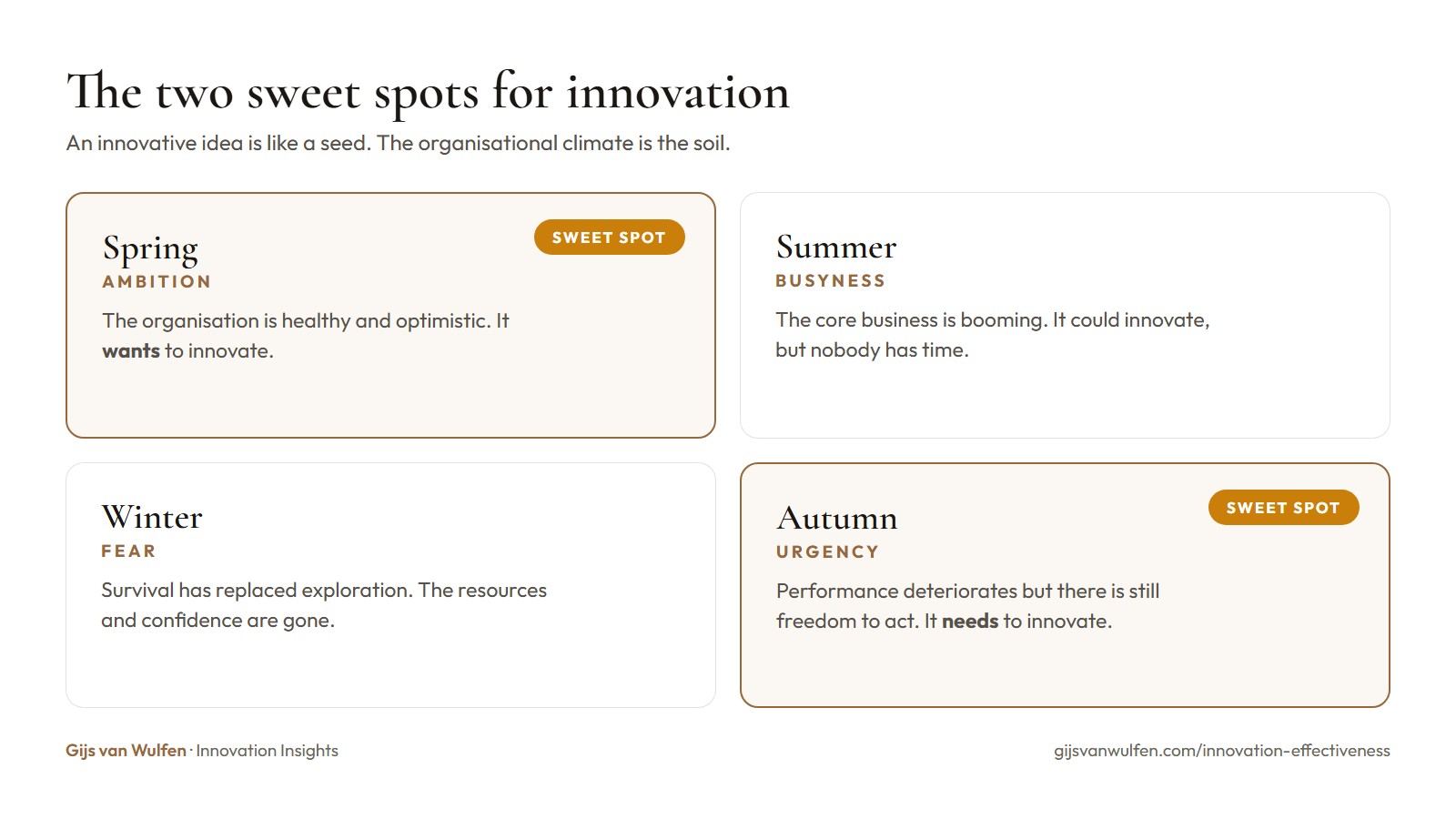
Innovation timing model by innovation expert Gijs van Wulfen: the two sweet spots for innovation. Organisations innovate most effectively in spring, when ambition makes them want to innovate, and in autumn, when urgency makes them need to innovate. In summer (busyness) and winter (fear) innovation rarely succeeds. Spring is the want-to-innovate window; autumn is the need-to-innovate window. From the article What Is Innovation Effectiveness on gijsvanwulfen.com.
The two sweet spots for innovation: organisations innovate most effectively in spring, when they want to innovate, and in autumn, when they need to innovate. Model by Gijs van Wulfen.

Spring: ambition

The organisation is healthy and optimistic. Leaders want to invest in future growth and people have the confidence and resources to explore. This is a fertile moment for innovation because the organisation wants to innovate.

Summer: busyness

The core business is booming. Everyone is busy serving existing customers and delivering today's success. Innovation appears unnecessary or receives insufficient attention. The organisation could innovate, but nobody has time.

Autumn: urgency

Performance is beginning to deteriorate, but the organisation still has resources and freedom to act. People recognise the necessity of finding new markets, products, services or business models. This is the second fertile period because the organisation needs to innovate.

Winter: fear

Business has deteriorated severely. Reorganisation, cost reduction and job insecurity dominate. Although the need for innovation may be enormous, the organisation lacks the confidence, patience and resources to support it. Survival has replaced exploration.

The two sweet spots are therefore:

Spring, when we want to innovate, and autumn, when we need to innovate.

Timing matters because an innovator may receive only one genuine opportunity to plant the seed. A proposition rejected at the wrong moment cannot always be presented again three months later with the same credibility and momentum.

Do not merely ask whether the seed is promising. Ask whether the organisational soil is ready.

Urgency can be more powerful than expertise

I once worked with a medium-sized Dutch construction company during an economic crisis. The construction market had collapsed. The company had already reorganised twice and lost one-third of its employees.

It had no innovation department, no marketing department, no market-research capability and little innovation experience. On paper, it was not an obvious innovation success story.

But it had something more powerful: urgency.

People understood that they had to enter new markets, develop new products and create distinctive business models that customers would buy. Innovation was not an attractive extra. It was necessary to protect jobs and secure the company's existence.

That shared urgency produced remarkable commitment. People worked with unusual discipline, learned quickly and fought for their organisation's future.

Urgency can compensate for a lack of innovation experience, but innovation experience cannot compensate for a lack of urgency.

Innovation effectiveness accelerates when innovation changes from something people would like to do into something they must do.

Why the Silicon Valley model does not work everywhere

Large corporations in banking, insurance and aviation often appear highly innovative. They operate incubators, startup hubs and innovation centres and organise workshops and hackathons.

Yet visible activity can disguise limited effectiveness. In financial technology, for example, many significant innovations originated in entrepreneurial startups rather than inside traditional banks. Banks frequently acquired the startups later.

This does not diminish the hard work of corporate innovators. It raises a structural question: are organisations building an internal ability to innovate, or are they performing innovation and purchasing the results elsewhere?

Many organisations have copied the Silicon Valley model without asking whether it fits their culture. Silicon Valley often celebrates the individual entrepreneur: me, myself and I. I call this I-innovation.

But most established organisations need WE-nnovation.

The reasons differ across cultures. Europe has strong traditions of social cooperation. Relationships and collective structures matter greatly in the Gulf region. In Japan, collective traditions are influenced by Buddhism and Shinto. But the organisational principle crosses cultures: people are more likely to implement what they helped create.

This produces another innovation paradox:

The fast way is often the slow way, and the slow way is often the fast way.

Separating innovation into an incubator appears fast. But returning its output to an organisation that feels no ownership makes implementation slow—or impossible.

Involving the organisation throughout the journey appears slower. Yet shared learning and ownership make it the faster path to implementation.

Do not present innovation to the organisation. Innovate with the organisation.

Five ways to double innovation effectiveness

If a CEO asked me what an organisation must change to double its innovation effectiveness, I would recommend these five actions—in this order.

1
Create a clear innovation assignment

Align innovation with the organisation's mission and strategy. Define what the organisation wants to achieve, where it will explore and what lies outside the assignment.

A good innovation assignment answers questions such as:

  • Why must we innovate now?
  • What strategic challenge or opportunity are we addressing?
  • How much impact or growth do we seek?
  • Which customers, markets or societal groups matter?
  • What boundaries will focus our exploration?
  • What will success eventually look like?

This direction should be specific enough to focus people but open enough to permit genuinely new solutions.

A vague innovation ambition produces vague results.

2
Structure the innovation journey

Creativity alone does not create impact. Organisations need a structured journey that moves from direction to discovery, ideas, tested concepts, business cases, implementation and scaling.

Structure creates innovation discipline: the habit of making continuous, evidence-based progress despite uncertainty.

It prevents teams from jumping directly from an idea to building a solution. It requires them to understand the problem, test the most critical assumptions, learn from customers and improve their concept before requesting significant investment.

The purpose is not to turn innovation into bureaucracy. The purpose is to prevent energy from disappearing between workshops and to help multidisciplinary teams move forward together.

Creativity generates possibilities. Structure converts possibilities into results.

3
WE-nnovate

Un-silo innovation. Invite people from different departments and organisational levels to participate actively—including the decision-makers who must eventually approve and support implementation.

Connect technology, operations, sales, marketing, finance and leadership. Let them learn from customers together, share their perspectives and develop solutions as one team.

When a CEO, CFO or CMO participates personally, innovation also becomes an organisational priority. Executive participation provides more than sponsorship. It gives the project legitimacy, attention and momentum.

The precise form of collaboration must fit the local and organisational culture. But the principle remains universal:

People support what they help create.

4
Embrace uncertainty

Uncertainty is the only certainty in innovation.

Established organisations are designed to deliver predictable results. Innovation asks them to make decisions about customers, technologies, markets and business models they do not yet understand completely. That tension cannot be eliminated.

The answer is not reckless risk-taking. Teams should identify assumptions, test them and progressively reduce uncertainty. Decision-makers should follow that learning process so they understand which risks have been removed and which remain.

An effective innovation process does not make an opportunity risk-free. It helps leaders decide whether the remaining uncertainty is worth accepting for the expected value.

Effective innovation enables people to take worthwhile risks deliberately.

5
Provide long-term support and resources

Innovation cannot survive on an annual budget and occasional executive enthusiasm.

Organisations often fund an innovation programme for one year, generate strong concepts and move several projects into development. Then a crisis arrives, budgets tighten and funding stops—before those projects could realistically have created impact.

A funnel filled with ideas is not innovation impact. Neither are plans, pilots or mini business cases. An innovation must be implemented and adopted before its value becomes visible.

Radical ideas often need at least three years and sometimes five to ten years to move from idea to substantial impact. Family businesses can have an advantage because they frequently invest for the next generation. For a publicly listed corporation, “long term” may mean the next financial year.

Organisations must therefore provide sustained people, time, funding and management attention. At the same time, innovation teams must work hard, learn quickly and maintain momentum because their window of support is never unlimited.

Innovation is a marathon that must be run like a sprint.

Finish with a business case, not an idea

People do not commit to innovation merely because it is new, exciting or fashionable. They commit when the expected value becomes explicit and the remaining risks appear worth taking.

That is why an innovation journey should not finish with an idea. It should transform a promising idea into a robust new business case—or, in social innovation, a social business case.

The business case should explain:

The business case is not merely a financial spreadsheet. It is the accumulated case for action.

How should organisations measure innovation effectiveness?

No single KPI can measure innovation effectiveness. Financial measures alone appear too late, while activity measures say too little.

Organisations should measure the journey at five connected levels.

1. Relevance

Are we addressing strategically important opportunities and meaningful customer or societal problems?

2. Learning

Are our experiments reducing the most critical uncertainties? Are we changing direction when the evidence requires it?

3. Conversion

How effectively do opportunities progress from insight to tested concept, business case, implementation and launch?

4. Adoption

Are customers, employees, partners or citizens actually using the solution? Do they continue using it?

5. Impact

Is the innovation producing financial, strategic, operational, customer, environmental or societal value?

Relevant indicators may include the percentage of projects grounded in validated customer problems, assumptions tested, uncertainties reduced, conversion rates between stages, time to a validated proposition, implementation ownership, adoption, repeat use, revenue, savings and societal outcomes.

The measurement principle is straightforward:

Measure evidence and progress early; measure adoption and impact later.

Innovation effectiveness is a human capability

Innovation methodologies, technologies and tools matter. But after more than 25 years, I believe that innovation effectiveness is ultimately determined by people.

Do they understand the assignment? Are they motivated by ambition or urgency? Do they have a structured path forward? Are departments and hierarchical levels connected? Do decision-makers learn with the team? Can people discuss uncertainty honestly? Does the organisation provide the time and resources required to reach impact?

Most promising innovations do not fail because they are technically impossible. They fail because the organisation never develops the shared confidence and ownership needed to act.

That is why innovation should not be delegated to a small group of specialists and presented to management at the end. The people who must approve, implement and use an innovation should become co-owners of its journey.

Innovation effectiveness improves when ambition becomes direction, creativity becomes discipline, participation becomes ownership, uncertainty becomes informed risk and short-term enthusiasm becomes long-term commitment.

Then innovation stops being theatre. It becomes impact.

Key takeaways

Frequently asked questions

What is innovation effectiveness?

Innovation effectiveness is an organisation's repeatable ability to turn innovation ambition into implemented solutions that create meaningful financial, strategic, customer, environmental or societal value.

What is the difference between innovation efficiency and innovation effectiveness?

Innovation efficiency concerns how well an organisation performs innovation activities. Innovation effectiveness concerns whether it chooses relevant opportunities and converts them into implemented solutions that create impact.

Why do promising innovations fail inside established organisations?

They commonly fail because the ambition is vague, the timing is wrong, people lack time, innovation is isolated, decision-makers have not participated, ownership is fragmented or long-term funding disappears before impact can be achieved.

When is the best time for an organisation to innovate?

The two best moments are when the organisation has ambition and resources to pursue future growth, or when it feels urgency but still has sufficient resources and freedom to act. Innovation is much harder when everybody is consumed by current success or when fear and survival dominate.

How can an organisation double its innovation effectiveness?

Start with a clear strategic innovation assignment. Structure the innovation journey, involve people across silos and hierarchy levels, embrace uncertainty through learning and experimentation, and provide sustained support and resources until implementation and impact.

How should innovation effectiveness be measured?

Measure relevance, learning and conversion during the early stages. Measure adoption and financial, strategic, operational, environmental or societal impact after implementation.

About the author

Gijs van Wulfen is an innovation keynote speaker, author and the founder of the FORTH Innovation Methodology. He has worked in innovation for more than 25 years, helping organisations turn innovation ambition into practical results.

He is the author of several books on innovation, including The Innovation Expedition, The Innovation Maze and Breaking Innovation Barriers. His work focuses on innovation effectiveness, overcoming innovation barriers, innovation discipline and turning ideas into impact.

The FORTH Innovation Methodology was developed from his practical experience of leading innovation projects and is used by organisations and certified facilitators around the world.