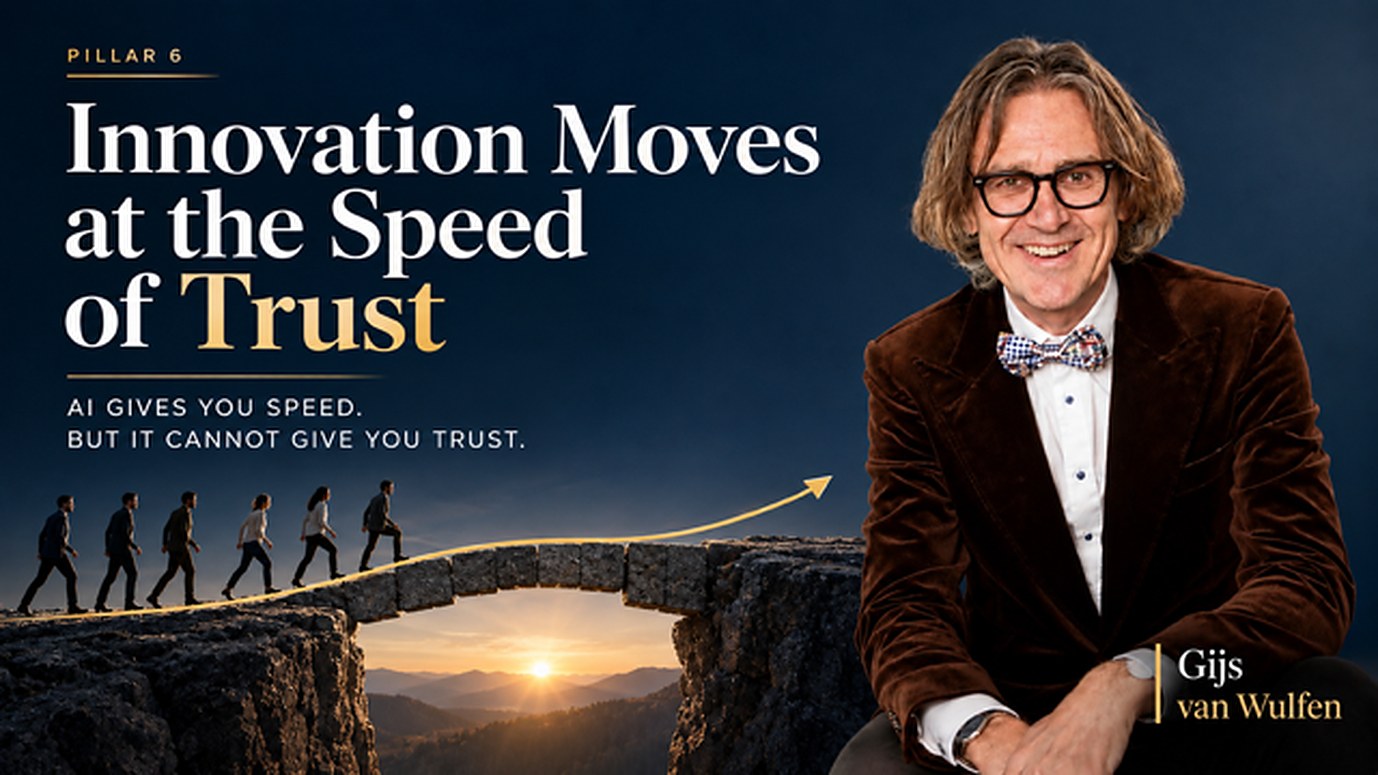
An Innovation Journey Builds Trust AI Can’t Give You
Why trust, ownership and the human journey become more important as artificial intelligence accelerates innovation
By Gijs van Wulfen · 4 November 2026 · 32 min read
Innovation moves at the speed of trust. Visual: Gijs van Wulfen
Artificial intelligence is transforming innovation.
AI can analyse thousands of customer comments in seconds. It can identify patterns in enormous datasets, explore technologies and trends, generate hundreds of ideas, visualise concepts, create prototypes, analyse experiments and help teams develop business cases.
Things that once took innovation teams weeks can increasingly be done in hours.
Wonderful.
As an innovation practitioner, I welcome every tool that makes innovation faster, smarter and more effective. But there is something AI cannot give you.
Trust.
After more than 25 years of guiding organisations through innovation journeys, I have come to see trust as one of the most underestimated factors in innovation success.
Most organisations do not suffer from a shortage of ideas. They suffer from a shortage of people willing to believe in those ideas strongly enough to act. Decision-makers hesitate. Departments defend their interests. People question the evidence. Managers worry about risk. Operations sees complications. Finance wants certainty. Teams lose momentum. Promising ideas get stuck somewhere between enthusiasm and implementation.
When there is little trust, innovation becomes talk. People attend workshops, admire possibilities and return to their desks. They may be afraid of being ridiculed, punished for failure or criticised behind their backs. They may distrust management intentions, doubt colleagues from other functions, question the innovation process or simply doubt whether the organisation will support them once the project becomes difficult.
Artificial intelligence does not remove this problem. It may even make it more visible. When ideas, concepts and business cases can be produced incredibly fast, we risk confusing the speed of producing innovation output with the speed at which an organisation can trust it. Those are two very different things.
The faster innovation becomes technologically, the more important the human innovation journey becomes organisationally.
AI can accelerate the journey. It can enrich it. It can challenge the people travelling it. But people still need to make that journey together, because the journey creates something an algorithm cannot generate: shared understanding, shared experience, shared ownership, shared conviction and trust.
Innovation is not an output. It is a journey.
Imagine the innovation process of the near future. You enter an innovation challenge into an AI system. It analyses the market, identifies customer frictions, finds trends, generates 500 ideas, evaluates them, develops the strongest concepts, creates visuals, simulates reactions, calculates a financial case and produces a beautiful management presentation. Perhaps all within a day.
Impressive.
But then you walk into the boardroom and somebody asks:
“Why should we believe this?”
Who met the customers? Who saw their frustration? Who discovered the opportunity? Who discussed the strategic choices? Who generated the ideas? Who experienced the disagreement? Who saw the first concept fail? Who listened when customers rejected something everybody internally thought was brilliant? Who changed their mind? Who made the difficult choices? And who is prepared to put their reputation behind the result?
Innovation is not only the creation of a new solution. It is also the creation of collective conviction around that solution. Collective conviction does not suddenly appear when you present the final business case. It grows during the journey.
Trust is the hidden infrastructure of innovation
Innovation Trust is the confidence people develop in the strategic direction, the customer need, the people involved, the creative process, the market evidence, the decision-making and the organisation’s ability to implement.
When we talk about trust in business, we often treat it as one broad concept. In innovation, I see different types of trust being created at different moments. They accumulate and reinforce each other.
Strategic trust. Do we agree on why we are innovating, where we want to go and what success means?
Customer trust. Is our understanding of the customer grounded in real observation rather than internal assumptions?
Internal trust. Do people from different functions trust each other enough to share knowledge, challenge assumptions and work beyond departmental interests?
Creative trust. Do people feel safe enough to share unfinished, unusual and even ridiculous ideas without being judged too early?
Market trust. Have customers and other external stakeholders given us enough evidence to believe the concept solves a meaningful problem?
Decision-maker trust. Do senior leaders understand the journey and the evidence well enough to commit resources to the outcome?
Implementation trust. Do the people who must implement the innovation understand it, believe in it and feel enough ownership to make it happen?
These forms of trust are not created by one inspirational workshop. They are built step by step, experience by experience. Together they create something even more valuable: innovation ownership.
“This is ours. We believe in it. And we are going to make it happen.”
What research tells us about safety and ownership
My view of Innovation Trust comes primarily from practice, but it connects strongly with established organisational research. Amy Edmondson’s work on psychological safety describes the importance of reducing interpersonal risk so that people can speak up, learn and perform in uncertain, interdependent work. That matters enormously in innovation, where nobody has all the answers and admitting “I don’t know” is often the beginning of learning.
Psychological safety, however, is not the same as Innovation Trust. Safety makes it possible to speak, question and experiment. Innovation Trust goes further: people also need confidence in the strategic direction, the customer evidence, their colleagues, the market response, the decision process and the organisation’s willingness to implement.
Research on psychological ownership offers another important connection. Pierce, Kostova and Dirks argued that people can develop a sense that something is “mine” even without legal ownership. More recent innovation research has gone further: a 2024 study by Alf Steinar Sætre, Amy Edmondson, Oda Dregelid and Sofie Rud Zimmer found that shared psychological ownership helped innovation projects cross departmental boundaries and enabled more effective handoffs. That finding is remarkably close to what I have experienced for years in multidisciplinary innovation journeys: ownership does not have to belong to one champion. It can be shared.
That is the essence of WE-nnovation: not one hero owning the idea, but many people feeling, “This is ours.”
Full Steam Ahead: build strategic trust
Innovation often starts too quickly. Someone wants ideas. Management organises a brainstorm. People receive Post-its and everybody starts creating. But generating ideas before agreeing on the innovation challenge is like starting an expedition without agreeing on the destination.
Ask ten executives what innovation means for their organisation and you may receive ten answers: growth, efficiency, digitalisation, sustainability, artificial intelligence, new business models, customer experience, cost reduction or future products. All may be legitimate. But if the people involved are solving different problems, more creativity will not help.
That is why the first phase of FORTH is called Full Steam Ahead. Before exploring solutions, the organisation aligns around the challenge. What do we want to achieve? Why does it matter? What is inside the scope? What is outside? Who should participate? Which decision-makers need to be involved? What will happen when we return with promising business cases?
This creates strategic trust. Everybody knows why the expedition exists and where it is supposed to go.
AI can help formulate an innovation challenge, compare strategic alternatives and analyse large quantities of information. But AI cannot make a management team genuinely commit to one direction. That requires conversation, trade-offs, choices, sometimes conflict and finally agreement.
The first act of innovation leadership is therefore not ideation. It is alignment.
Observe & Learn: build customer trust
Stop thinking. Start looking.
Once the challenge is clear, most organisations want to start brainstorming. I prefer to go outside first. Observe customers. Talk to non-customers. Meet experts. Explore emerging technologies. Study trends. Visit other sectors. Experience the problem.
In FORTH, this phase is Observe & Learn. It matters because people start replacing assumptions with observations. Marketing may discover something operations has been saying for years. An engineer may hear a customer describe a problem nobody had put into technical requirements. Finance may discover why customers are willing to pay for something the organisation considered unimportant.
The language changes from “I think...” to “We saw...” That difference is enormous. It creates customer trust: the team’s confidence that the opportunity is grounded in something real.
Customer trust also reduces politics. A debate between functions can continue indefinitely because every department has its own logic. A real customer friction changes the conversation. The question becomes less “Whose opinion is right?” and more “What are we going to do about what we discovered?”
The Bruil story: trust after crisis
I experienced this powerfully with Bruil, a Dutch company in the construction sector. The context matters. This was not a comfortable group of professional innovators sitting in a creative laboratory. People in the organisation had lived through serious pressure and reorganisations. Some participants came from the factory floor. There were understandable reasons to be sceptical about another management initiative.
That is precisely why the journey mattered. People did not receive a PowerPoint telling them that customers had problems. They went out and discovered frictions themselves. They met repeatedly during the journey. They began to see what colleagues from other parts of the organisation could contribute. Somebody you might initially dismiss turns out to have an observation or practical insight that changes the concept.
Trust was not created through a team-building exercise. It emerged through doing meaningful work together.
Bruil used innovation to explore a different future. One of the directions that emerged was 3D-printed concrete. That changes the question completely. Instead of asking, “How can we make our current concrete products a little better?”, you ask, “What becomes possible when concrete no longer has to be produced in the traditional way?”
Suddenly shapes change. Production changes. Design freedom changes. Construction processes change. The relationship between architect, engineer and manufacturer changes. The innovation journey contributed to a radically different view of what the company could become.
Once people have discovered a new reality themselves, you no longer have to persuade them with 50 PowerPoint slides. They were there. They saw it.
Internal trust: from departments to one innovation team
Multidisciplinary teams look wonderful on organisation charts. In reality, people arrive carrying years of organisational history. Marketing thinks engineering always says no. Engineering thinks marketing promises things that cannot be delivered. Operations thinks innovators underestimate complexity. Finance thinks everybody ignores economics. The business thinks innovation lives in an ivory tower.
Innovation therefore requires more than diversity. It requires internal trust.
People need to understand why colleagues see the world differently. They need to discover that disagreement is not necessarily resistance. Often it is expertise. The engineer asking difficult feasibility questions may be helping make the idea implementable. The financial specialist challenging the business model may be protecting the future of the concept.
This trust develops over repeated encounters. People see who keeps promises, who listens, who contributes, who admits mistakes and who helps the team move forward. That is why a journey is fundamentally different from a one-day workshop. Relationships have time to develop through work.
Innovation teams become powerful when people stop defending functions and start solving the challenge together. AI can connect information. It cannot create the relationship between two colleagues who previously distrusted each other and now realise: “We actually need each other.”
Raise Ideas: build creative trust
AI has changed idea generation dramatically. Ask a generative AI system for 100 ideas and it will happily give you 100. Ask for another 100 and it will continue. Quantity is becoming almost free.
But innovation was never really about the number of ideas. It is about whether people dare to explore ideas that do not yet make sense.
That requires creative trust.
During Raise Ideas, the third phase of FORTH, I deliberately ask people to postpone judgement. Not forever. Just long enough to explore. Organisations train people to judge. Managers judge proposals. Engineers judge feasibility. Finance judges profitability. Marketing judges attractiveness. Colleagues judge each other. Useful later. Deadly too early.
Creative trust means I can suggest something strange without being ridiculed. You can build on my idea without taking it away from me. I can challenge yours without attacking you. We can combine two mediocre thoughts into one promising direction. Nobody needs to know whose idea it originally was.
That is WE-nnovation.
WE-nnovation: innovation is not a solo sport
For decades, business culture has romanticised the individual innovator: the genius, the visionary, the innovation champion, the entrepreneur fighting the organisation.
I have never believed that this is how innovation works in established organisations. One person may have a brilliant idea. But one person cannot usually develop, approve, finance, produce, market, sell and implement it alone.
The innovation-champion metaphor can even become counterproductive when it creates territorial ownership: my project, my idea, my success. Corporate innovation needs psychological ownership without territorial isolation.
That is why I use the term WE-nnovation. People discover together, create together, test together, learn together and eventually commit together. Psychological ownership can be shared by many people.
Innovation is not: “Look at my brilliant idea.” It is: “Look at what we discovered and created together.”
When AI became a member of the innovation team
While experimenting with AI in ideation, we treated AI almost like another member of the team. People generated ideas. AI generated ideas. We mixed them and looked at which ideas people wanted to take forward.
The AI ideas could be clever, surprising and objectively good. But they did not automatically attract ownership. One reaction captured it perfectly:
“They aren’t ours.”
That sentence reveals something fundamental. The quality of an idea is not only intellectual. It is also psychological.
People need processing time. They need to understand an idea, play with it, add something to it, write it down, combine it with another thought, discuss it and gradually start to love it. That process may look inefficient compared with instant generation, but it is precisely how an idea moves from something outside us to something we feel responsible for.
So the role of AI changes. Let people start. Then let AI challenge them, expand their thinking, offer alternatives, combine possibilities and take their first thought somewhere unexpected. Let people process those provocations and make them their own.
The result becomes:
My idea, powered by AI.
That feels fundamentally different from “AI’s idea, presented to me.” The difference may look small, but for innovation ownership it is enormous.
AI is extraordinary at speed, imagination, experimentation, divergence and convergence. Use all of that. But do not outsource the human experience of ownership to the machine.
Test Ideas: build market trust
Ideas are seductive, especially your own. Once a team has created a concept, people start defending it. That is why innovators need to leave the building again.
In Test Ideas, concepts are confronted with reality. In a FORTH journey, a team may enter this phase with roughly 12 to 18 concepts. That is deliberate. At this point we do not pretend we already know which concepts deserve to survive.
Testing is much richer than asking customers, “Do you like this?” We want to know whether they recognise the friction behind the concept. Do they understand the proposed solution? Does it attract them? Does it fit their situation? What is the strongest element—the top? What should be improved—the tip? What would stop them adopting or buying it?
Then we listen.
Perhaps half of the concepts are simply not good enough. Excellent. That is not failure. That is exactly why we test before spending serious money. Weak concepts disappear. Promising concepts improve. Assumptions become evidence.
The purpose of testing is not to prove that you were right. It is to discover where you were wrong before it becomes expensive.
This creates market trust. The team moves from “We believe customers will want this” to “We tested it, this is what customers actually told us, and this is how we improved the concept.”
AI can help enormously here. It can analyse interview transcripts, cluster feedback, identify recurring patterns, compare segments, suggest prototype variations and help teams formulate new hypotheses. But the confidence does not come from the algorithm. It comes from confronting assumptions with the outside world.
Market trust is therefore evidence-based confidence, not optimism.
The CCI story: from “my job” to “our future”
One of my favourite examples of WE-nnovation comes from CCI, a medium-sized Dutch confectionery company. The innovation challenge became “Sweets for All.”
During the journey, something dramatic happened: the factory burned down.
Imagine the situation. Production capacity destroyed. Customers waiting. Employees needing answers. Money at stake. An organisation under enormous pressure.
What would most companies do?
Stop innovation.
Of course. There are more urgent priorities.
But the CEO saw it differently. Innovation had become more important, not less. If you have to rebuild your factory, you face a fundamental strategic question:
What do we want this factory to produce in the future?
That changed the meaning of the innovation journey. It was no longer an interesting project alongside the business. It became part of deciding what the future business should become.
And the CEO did something else that matters enormously. He did not sit at a distance waiting for the final presentation. He became the project leader.
He travelled the journey. He saw the evidence. He experienced the choices. He participated in the creation. His presence also sent a message to everybody else: this matters. Leaders communicate priorities not only by what they say, but by where they spend their time.
There was another wonderful transformation. At first, the R&D director was uncomfortable with the multidisciplinary approach. Suddenly everybody was involved in innovation. His initial reaction was essentially:
“Everybody is now doing my job.”
Later, his perspective changed completely:
“Everybody is helping me.”
For me, that is WE-nnovation in two sentences.
Nothing about the formal organisation necessarily had to change. What changed was trust. Innovation stopped being somebody’s territory and became a shared responsibility. Psychological ownership expanded instead of being transferred.
Roughly a year later, the innovation reached the market. The journey had not merely produced a concept. It had helped create the organisational conviction needed to implement it.
Decision-makers must join the journey
The CCI story illustrates one of my strongest convictions about innovation governance.
I am not a fan of the traditional steering committee.
The innovation team travels the journey. Management stays behind. Every few weeks the team returns, presents PowerPoint slides and receives a go or no-go from people who have not experienced what the team experienced.
This creates a structural trust problem.
The innovation team thinks: “Why don’t they understand?” Management thinks: “Why should we believe you?” Both reactions are logical. They experienced different realities.
My solution is simple:
Let decision-makers join the journey.
They do not need to attend everything. In a 15-week FORTH journey, a senior decision-maker may participate for roughly 7.5 days at carefully selected moments. They can join the departure, participate in important observations, experience ideation, see concept choices, hear customer reactions and be present when business cases take shape.
Seven and a half days across fifteen weeks is not an excessive management burden when the organisation may later be asked to invest hundreds of thousands or millions and years of effort.
More importantly, participation changes the final decision. Management is no longer seeing the innovation for the first time. Leaders recognise the journey behind it. They know why choices were made. They have seen evidence accumulate. They know where uncertainty remains.
This creates decision-maker trust before the investment decision rather than trying to manufacture buy-in afterwards.
And participation itself is symbolic. If a CEO repeatedly says innovation is strategically crucial but never has time to join the journey, people notice. Absence communicates priority just as clearly as presence.
Breman: AI innovation through a human journey
A recent FORTH journey at Breman makes this especially relevant because the innovation challenge itself concerned AI and robotics.
Breman could have treated AI as a technology project: bring in experts, ask them to identify use cases, produce an AI roadmap and present it to the organisation.
Instead, people travelled an innovation journey together.
They started with 173 relevant frictions. Those observations became 1,191 ideas. The ideas were narrowed to 67 directions and then to 18 concepts. Sixteen concepts were tested. Twelve were improved. Six business cases were developed. Three were selected.
Look at the funnel:
173 frictions
1,191 ideas
67 directions
18 concepts
16 tested
12 improved
6 business cases
3 selected
The numbers are impressive, but the most important question is: who travelled the journey?
A multidisciplinary core team and decision-makers participated. The people who would ultimately have to believe in AI and robotics were involved in discovering where those technologies could create value.
By the time the business cases reached the final decision, they were not mysterious AI proposals created somewhere else. They were the result of shared observation, creation, testing and choice.
The innovation involved artificial intelligence. The trust was built by humans.
This is why I do not believe the future is AI replacing innovation teams. The much more interesting opportunity is AI strengthening teams while the journey creates the human conditions for adoption.
Homecoming: build implementation trust
Every expedition eventually comes home. That is why the fifth stage of FORTH is called Homecoming.
The innovation team has explored, observed, created, failed, tested, improved and learned. But the rest of the organisation may not have changed with them. Innovators return excited. Operations sees disruption. Finance sees investment. Management sees risk.
This is where many promising innovations die. Not because the concept is bad, but because the organisation does not trust it enough.
Homecoming therefore translates exploration into a credible business proposition. Is there genuine customer value? Is the proposition attractive for the organisation? Can it create sustainable financial value? Is it feasible? What evidence do we have? What assumptions remain? What resources and next steps are required?
A business case should not pretend uncertainty has disappeared. Innovation is still innovation. There are still assumptions. But the quality of the journey should have reduced uncertainty enough to make the next investment rational.
That investment may be €500,000. It may be €1 million. It may eventually be much more. And investment means far more than money. It means people, time, management attention, production capacity, priority, reputation and commitment.
That is why implementation trust matters. Senior leaders must trust the evidence enough to allocate scarce resources. The receiving organisation must trust the concept enough to make room for it. The team must trust management enough to believe the project will not disappear at the first setback.
Ownership cannot be transferred at the end. It has to be built during the journey.
A handover is a weak substitute for shared ownership. This is also why the recent research on shared psychological ownership across innovation handoffs is so relevant: the organisational boundary between “the innovators” and “the business” is often exactly where good ideas lose momentum.
Is fifteen weeks too long in the age of AI?
This is where the AI debate becomes especially interesting.
FORTH is a 15- to 20-week innovation journey. In an age in which AI can generate an answer in seconds, fifteen weeks may sound slow.
But compared with what?
If your organisation has been struggling for ten years to make innovation work, is fifteen weeks really too long? If ideas have circulated for years without decisions, projects repeatedly die after the pilot, management and innovators distrust each other, or nobody feels ownership for implementation, the relevant comparison is not fifteen weeks versus fifteen minutes.
The relevant comparison is fifteen weeks versus years of indecision, politics and failed implementation.
AI should absolutely make the journey faster and better. Use it for desk research. Use it to analyse thousands of observations. Use it to identify patterns. Use it to provoke ideas. Use it for divergence and convergence. Use it to visualise concepts. Use it to prepare experiments. Use it to analyse feedback. Use it to accelerate documentation and financial modelling.
Compress the work that should be compressed.
But be careful about compressing the human experiences that create ownership: meeting customers, confronting assumptions, creating together, disagreeing constructively, processing new ideas, testing, learning and deciding.
Humans need processing time. A team may intellectually understand an AI-generated proposal in minutes and still not feel any commitment to it. People need to connect the new direction to their own experience. They need to talk about consequences. They need to see how colleagues respond. They need to develop confidence that others will support the decision when implementation becomes difficult.
Technological speed and organisational adoption operate on different clocks.
Just because AI can create a concept faster does not mean people can trust it faster.
The leadership challenge is therefore not to choose between speed and trust. It is to use AI to create speed where speed adds value, while deliberately protecting the parts of the journey where human trust is formed.
AI should accelerate the journey, not eliminate it
I am not arguing for less AI in innovation. Quite the opposite. I am arguing for better use of AI.
Let AI analyse enormous datasets, find patterns, summarise research, explore technologies, challenge assumptions, generate alternatives, create images, develop prototype variations, analyse testing feedback and support financial modelling.
Then reinvest some of the time you save in what humans do best: observe, listen, talk, challenge, experiment, judge, decide, build relationships, create meaning and take responsibility.
This is an important distinction. If AI allows three people to produce in three days what twenty people previously created together in three months, you may have achieved spectacular efficiency. But you may also have removed seventeen people from the process of discovery and ownership.
Then the three people arrive with their brilliant proposal and wonder why the other seventeen ask, “Why should we believe you?”
Efficiency can therefore create an adoption deficit if we optimise only the production of innovation outputs.
The objective is not maximum innovation speed. The objective is maximum innovation effectiveness.
From artificial intelligence to collective intelligence
The future of innovation is not human versus AI. That is the wrong debate.
The opportunity is human with AI.
AI brings computational power. Humans bring context.
AI brings speed. Humans bring judgement.
AI brings alternatives. Humans bring meaning.
AI can generate. Humans can care.
AI can recommend. Humans must decide.
AI can help us imagine what might be possible. Humans must decide what is desirable, responsible and worth committing to.
When those strengths are combined properly, we move beyond artificial intelligence towards collective intelligence: multidisciplinary people, decision-makers, customers and AI contributing what each does best.
That is the future I believe in: not innovation with fewer humans, but better human innovation amplified by AI.
The seven types of Innovation Trust
The trust architecture can now be summarised as a journey rather than a checklist.
Strategic trust gives the journey legitimacy. We agree on the challenge, the direction and why it matters.
Customer trust gives the journey relevance. We have observed genuine needs and frictions instead of relying on assumptions.
Internal trust allows different functions and levels to work as one team instead of defending territories.
Creative trust allows people to explore unfinished and unconventional possibilities without premature judgement.
Market trust replaces enthusiasm with external evidence by testing concepts and improving them.
Decision-maker trust grows when leaders participate in the journey and understand where the choices and evidence came from.
Implementation trust turns a business case into commitment by giving the organisation enough confidence to allocate money, people, time, capacity and priority.
The sequence matters. Each form of trust makes the next one easier to build. Together they create innovation ownership.
And ownership is the bridge from ideas to impact.
CEO perspective: what leaders should do differently
For CEOs and executive teams, the implication is practical. Do not measure an innovation process only by how quickly it produces concepts. Measure whether it produces commitment.
Define one strategic innovation challenge before asking for ideas. Clarity at the start prevents creativity from becoming strategic noise.
Build a genuinely multidisciplinary team. Do not delegate innovation to R&D, marketing, digital or an innovation department alone.
Join the journey. Leadership presence creates decision-maker trust and signals that innovation really matters.
Use AI aggressively for speed, analysis and exploration. There is no virtue in doing manually what AI can do better and faster.
Protect human processing time. Do not confuse an instantly generated answer with an instantly owned answer.
Insist on customer evidence. A concept should earn market trust before it earns major investment.
Build shared ownership before Homecoming. Do not leave implementation buy-in until the final presentation.
Treat investment broadly. Money is only one resource. Implementation also consumes management attention, talent, capacity, reputation and priority.
Judge innovation effectiveness by implementation. A beautiful pipeline of concepts that nobody wants to own is not innovation success.
For a CEO, perhaps the most useful question at the end of an innovation journey is therefore not only:
“Is this a good idea?”
It is also:
“Do enough of the right people believe in this strongly enough to make it happen?”
Lessons learned from 25+ years of innovation journeys
1. Trust is not soft; it is operational
Trust determines whether people share information, challenge assumptions, admit uncertainty, support decisions and allocate resources. In innovation, those behaviours directly affect speed and implementation.
2. Buy-in at the end is usually too late
If you wait until the business case is finished to involve the people who must approve or implement it, you have created an avoidable trust gap. Build ownership throughout the journey.
3. Customer evidence is a social force inside organisations
Testing does more than improve concepts. It changes internal conversations. External evidence allows people to change their minds without losing face.
4. Shared ownership is stronger than territorial ownership
The innovation champion has value, but the lone-hero model is insufficient for complex corporate innovation. WE-nnovation creates multiple owners who can carry the idea across functions.
5. Leaders build trust with their calendars
If innovation is strategic, leaders need to participate at critical moments. People notice where leaders spend their time.
6. AI changes the economics of innovation, not the psychology of ownership
Research, ideation, prototyping and analysis can become dramatically faster. Human beings still need agency, understanding and participation to develop commitment.
7. Failure during testing can increase trust
A concept that fails cheaply during Test Ideas is not a wasted concept. It is evidence that the process is working. Teams learn that they do not need to defend every idea; they need to discover what works.
8. The journey is part of the result
A business case is an output. A team that understands the opportunity, trusts the evidence and owns the direction is an organisational capability. The journey creates both.
Key takeaways
AI gives innovation speed, but speed is not the same as trust.
Innovation Trust consists of strategic, customer, internal, creative, market, decision-maker and implementation trust.
Trust accumulates through shared experiences during the innovation journey.
Psychological safety enables people to speak and learn; Innovation Trust extends into confidence in direction, evidence, decisions and implementation.
People support ideas more strongly when they participate in discovering, creating and testing them.
WE-nnovation is the alternative to the lone-innovation-champion myth: psychological ownership can be shared.
“My idea, powered by AI” creates a different relationship from “AI’s idea, presented to me.”
Testing 12-18 concepts is not about proving ideas right; it is about reducing uncertainty and building market trust.
Decision-makers should participate in the journey rather than judge it only from a steering committee.
Leadership presence is itself a signal of strategic priority.
Homecoming must create enough confidence to invest not only money, but people, time, capacity and management attention.
Fifteen weeks is not slow when the alternative is years of indecision, politics and failed implementation.
AI should compress mechanical work without eliminating the human experiences that create ownership.
The goal is not maximum innovation speed. It is maximum innovation effectiveness.
AI can help create an innovation. The human journey creates the trust to implement it.
Frequently asked questions
What is Innovation Trust?
Innovation Trust is the confidence people develop in the strategic direction, the customer need, the people involved, the creative process, the market evidence, the decision-making and the organisation’s ability to implement. It is not one moment of belief. It accumulates throughout an innovation journey.
Why is trust important in innovation?
Innovation asks people to commit resources and reputations to something uncertain. Without trust, people protect themselves, postpone decisions and defend functional interests. Trust reduces the organisational distance between an idea and action.
What are the seven types of trust in an innovation journey?
The seven types are strategic trust, customer trust, internal trust, creative trust, market trust, decision-maker trust and implementation trust. Together they create the conditions for shared innovation ownership.
How does an innovation journey build trust?
A structured journey lets people experience the evidence and choices together. They align on the challenge, observe customers, collaborate across functions, create ideas, test concepts, learn from feedback and develop business cases. Each shared experience gives people another reason to believe.
What is the difference between psychological safety and Innovation Trust?
Psychological safety concerns interpersonal risk: whether people feel able to speak up, ask questions, admit mistakes and contribute without fear of humiliation. Innovation Trust is broader. It also includes confidence in strategy, customer relevance, market evidence, decision-makers and implementation.
What is the difference between Innovation Trust and innovation ownership?
Trust is confidence in the people, process, evidence and direction. Ownership is the willingness to take responsibility for the result. Trust helps ownership develop; ownership turns innovation into implementation.
Can AI build trust in an innovation team?
AI can support trustworthy work by providing analysis, alternatives, evidence and transparency. But it cannot replace interpersonal trust or psychological ownership. Those emerge through human interaction, agency, shared experience, responsibility and decision-making.
How should organisations use AI during ideation?
Use AI to provoke, expand, combine and challenge human ideas rather than automatically replacing human creation. Let people engage with AI suggestions and develop them. The aim is to preserve agency and ownership while gaining AI’s speed and breadth.
Why can AI-generated ideas feel less owned?
People often develop psychological ownership through participation. They invest thought, time, judgement and personal contribution. A fully formed idea arriving from outside may be intellectually strong but psychologically distant. “My idea, powered by AI” can therefore create more ownership than “AI’s idea, presented to me.”
What is WE-nnovation?
WE-nnovation is my term for innovation as a collective achievement rather than the work of a lone genius. People from different functions and levels discover, create, test and commit together, allowing psychological ownership to be shared.
What is market trust in innovation?
Market trust is confidence built from external evidence. It emerges when concepts are tested with customers and improved based on what people actually value, rather than what the internal team assumes they value.
Why test 12 to 18 concepts?
Because early innovation should preserve alternatives long enough to learn. Testing multiple concepts allows weak ideas to fail cheaply and stronger ones to improve before major resources are committed. The objective is not to defend every concept; it is to discover which opportunities deserve investment.
Why should decision-makers join an innovation journey?
A final presentation cannot reproduce weeks of discovery and learning. When decision-makers experience critical moments themselves, they understand where evidence and choices came from. This builds decision-maker trust before the final investment decision and reduces the need to create buy-in afterwards.
Does AI make a 15- to 20-week innovation process obsolete?
No. AI can compress research, analysis, ideation support, visualisation, prototyping and documentation. But customer encounters, multidisciplinary collaboration, testing, decisions and ownership still require human participation. The right goal is to accelerate the work without eliminating the journey.
How can CEOs increase innovation effectiveness in the AI era?
Create a clear strategic challenge, involve multidisciplinary teams and decision-makers, use AI to accelerate analytical and creative work, insist on customer testing, and deliberately protect the shared experiences that create trust and ownership.
Can trust really be designed into an innovation process?
Trust cannot be commanded, but the conditions that allow it to develop can be designed. A clear challenge, multidisciplinary participation, direct customer contact, psychological safety, evidence-based testing, visible leadership involvement and shared decision-making all make trust more likely to grow.
These studies support the literature-based elements of this article. The seven-part Innovation Trust framework, the FORTH journey interpretation, WE-nnovation and the cases and practitioner lessons are drawn from my own innovation practice.
AI can help you create an innovation. An innovation journey builds the trust AI can’t give you.
Thirty to sixty minutes as a keynote, two to four hours as a workshop. Tell him the date, the audience and the format.
About the author
Gijs van Wulfen is an international innovation keynote speaker, author and founder of the FORTH Innovation Methodology. For more than 25 years, he has helped organisations around the world turn innovation ambition into execution by combining structure, creativity, experimentation, collaboration and ownership.
His work focuses on innovation effectiveness, breaking innovation barriers, innovation discipline, innovation ownership, structured innovation with FORTH, and the human trust required to turn ideas into impact. His philosophy of WE-nnovation challenges the myth of the lone innovator: successful innovation is a shared journey in which people explore, create, learn, test and commit together.
Gijs is the author of several books on innovation, including The Innovation Expedition, The Innovation Maze and Breaking Innovation Barriers. His central message for the AI era is simple: use artificial intelligence to accelerate innovation, but never confuse faster output with stronger ownership.