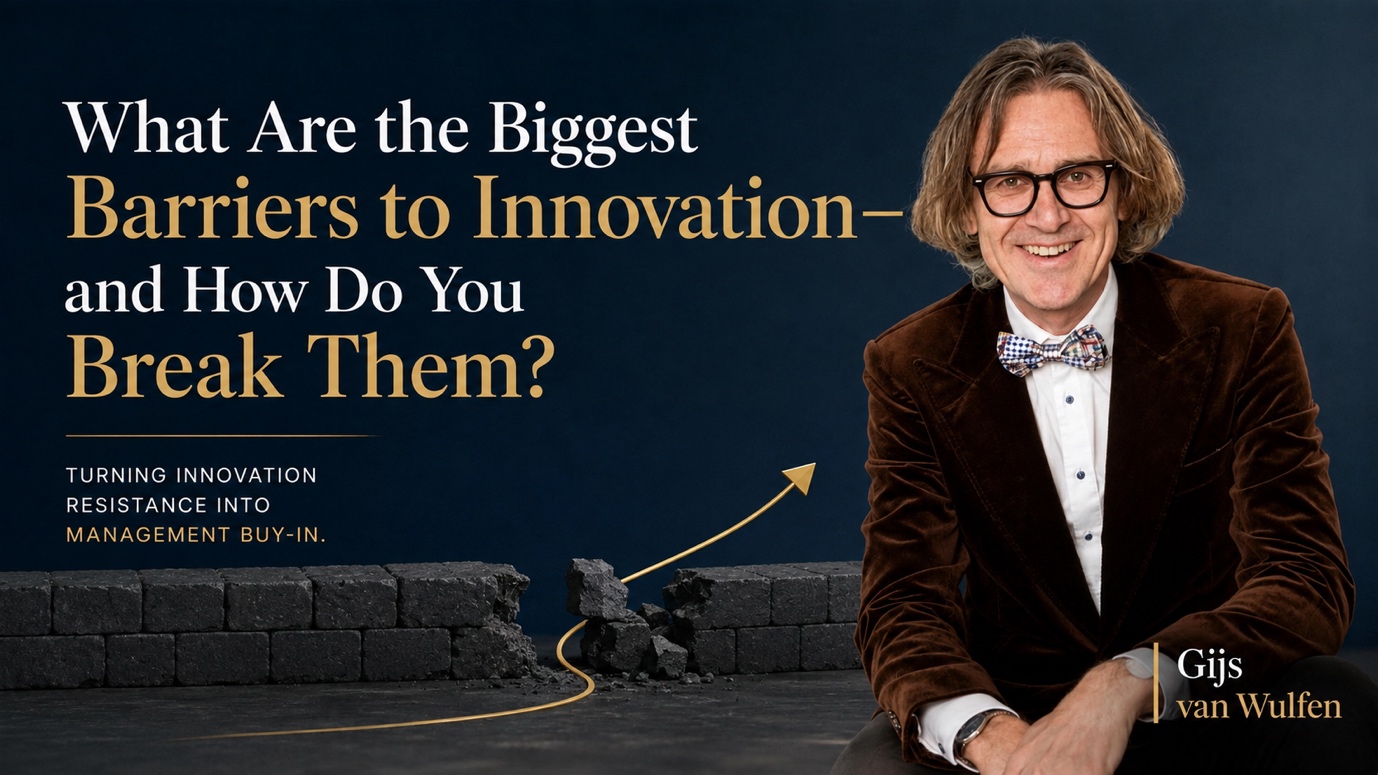
What Are the Biggest Barriers to Innovation—and How Do You Break Them?
Innovation barriers are the organisational habits, beliefs, structures and management behaviours that prevent people from turning promising ideas into real impact. They can appear anywhere—from the fuzzy front end of innovation to the implementation and scaling of a new product, service, process, business model or social innovation.
By Gijs van Wulfen · 9 September 2026 · 29 min read
Want this conversation in your organisation?
Gijs turns this thinking into a keynote or a workshop, tailored to your audience. Four talks, each built for a different problem.
Thirty to sixty minutes as a keynote, two to four hours as a workshop. Tell him the date, the audience and the format.
But a barrier does not have to be the end of your innovation.
It is where the real innovation journey begins.
Most organisations say they want innovation.
Their leaders call for new ideas, ambitious growth, digital transformation and business models for the future. They organise innovation challenges, hackathons, accelerators and design-thinking workshops. Employees are invited to think outside the box and challenge the status quo.
Then somebody presents a genuinely new idea.
Suddenly, the enthusiasm disappears.
“It is too risky.”
“It is too expensive.”
“This is not the right moment.”
“It does not fit our strategy.”
“We have tried something similar before.”
“Our customers are not asking for it.”
And, of course:
“That is not how we do things here.”
This is the innovation paradox. Organisations want innovation—but they struggle with the unfamiliarity, uncertainty and organisational change that real innovation creates.
After more than 25 years of working with innovators and established organisations around the world, I have learned that good ideas rarely fail because of the idea alone. They fail because people cannot overcome the resistance surrounding them.
That resistance may be cultural, organisational, political, financial, strategic, procedural or deeply personal. Most of the time, several barriers reinforce one another.
In this article, I will explain what an innovation barrier is, why people resist promising ideas, which 15 barriers block innovation most often and which 15 strategies help innovators win management buy-in.
What is an innovation barrier?
An innovation barrier is any organisational habit, belief, structure or management behaviour that prevents people from turning promising ideas into real impact.
Barriers can appear throughout the innovation journey:
when an organisation tries to define where and why it should innovate;
when people explore new technologies, customers or markets;
when teams create and select ideas;
when concepts are tested;
when management must approve an investment;
when a solution must be implemented;
when an innovation must be adopted and scaled.
The barriers can be organisational, cultural, personal or situational.
Organisational barriers include bureaucracy, silos, conflicting responsibilities and established systems. Cultural barriers appear in shared beliefs such as “failure is unacceptable” or “that is not how we do things here.” Personal barriers arise from individual priorities, emotions, careers, status and performance targets. Situational barriers include poor timing, declining results, limited resources or a lack of urgency.
An innovation barrier is therefore rarely just a practical obstacle.
A rejected investment request may appear to be about money. In reality, the CFO may be worried about missing an annual profit target. An objection about strategy may conceal a manager’s fear of losing influence. A request for more research may reflect discomfort with uncertainty rather than a genuine lack of evidence.
The barrier people mention first is not necessarily the barrier you need to break.
The real innovation journey starts with the first no
Many innovators interpret a no as the end of the journey.
Real innovators understand that it is the beginning.
When you develop something genuinely new, you will encounter resistance. If everybody immediately understands and supports your idea, it may not be very innovative. Real innovation challenges existing assumptions, priorities, processes, power structures and ways of working.
You may need to transform ten, twenty or even fifty noes into yeses before your innovation reaches implementation.
This does not mean ignoring criticism or persisting blindly. Sometimes an objection is valid. The proposition may solve no meaningful problem. The evidence may be weak. The timing may be wrong. The expected value may not justify the investment. Another opportunity may offer greater potential.
Innovators must therefore distinguish between two types of objections:
An unvalidated objection, rooted primarily in fear, politics, habit, misunderstanding or personal interests.
A validated objection, supported by evidence and providing a legitimate reason to improve or stop the initiative.
This distinction requires honesty.
Innovators should not automatically portray themselves as courageous heroes and managers as conservative blockers. Sometimes management resistance must be broken. Sometimes the innovator must listen, learn and let go.
A barrier should not stop you automatically. It should make you investigate.
Why do good ideas encounter resistance?
Most of the time, good ideas encounter resistance because they are not theirs.
Imagine that you have children. Do you love your children?
Of course.
Your neighbours may also have children. Do you like the children of your neighbours?
Probably.
But do you love them as much as your own children?
That is different.
The essential difference is ownership. Your children are yours. You feel connected to them, responsible for them and prepared to make sacrifices for them.
Ideas work in much the same way.
We love what we create. We defend it, nurture it and extend our limits to help it succeed. Somebody else’s idea is the child of the neighbours. We may appreciate it, but we do not automatically feel responsible for its future.
That is when rational objections appear:
“It is too expensive.”
“It is too risky.”
“Not now.”
“It does not fit our strategy.”
Would you use those arguments so quickly against your own child? Probably not. You would look for possibilities, find resources and fight for its future.
Ownership changes the way people judge an idea.
That is why management buy-in should not be requested only at the end of an innovation journey. It must be developed throughout the journey.
People support what they help create.
The painful rejection that changed my view of innovation
One of my most painful professional experiences occurred when I was working as a marketer for a confectionery company.
The company needed growth. Nine months earlier, the CEO had personally asked us to develop a new product that could generate revenue that same year.
“Get a team together and get going,” he told us.
We assembled a cross-functional new-product development team. Every relevant department participated. We followed the process, conducted research, developed the proposition and prepared the launch.
We did everything according to the book.
Then we presented the final proposal to the board of directors.
I sensed tension as soon as I entered the room.
“But what about this?”
“But what about that?”
Question followed question. Objection followed objection.
I could not understand what was happening. These were the same executives who had asked us to innovate quickly. They had pushed us to present the proposal before the summer so that we could launch in September.
Finally, the CEO said:
“I think we should make a decision after the summer holidays.”
I was furious.
After all our work and all their urgency, they postponed their own decision. In practice, postponement meant rejection.
I was too angry to respond. I left the room without even saying goodbye. The team was devastated and did not understand the decision either.
Only later did I recognise what had really happened.
Our company was the least profitable of 14 operating companies in the group. The board was under enormous pressure. Another failure could cost the executives their positions—and eventually it did.
We had evaluated the proposal rationally. They experienced it emotionally and personally.
To us, the innovation represented growth.
To them, it represented a risk that could end their careers.
At the time, I blamed conservative management. Years later, I understood that the process was wrong. We had travelled the complete innovation journey, accumulated the insights and gradually developed confidence in the proposition.
The board encountered all its unfamiliarity and uncertainty during one final presentation.
We tried to convince them. But decision-makers cannot confidently approve an innovation journey they have not travelled themselves.
You cannot convince decision-makers.
They must convince themselves.
Why innovators create their own resistance
When you point one finger at somebody else, three fingers point back at you.
Innovators often contribute to the resistance they encounter.
They fall in love with their ideas. Every critical question feels like criticism of their competence, ambition or identity. A rejection of the proposition feels like a personal rejection.
Their ambition creates tension. Because they feel that they must succeed, they start pushing.
They explain more.
They argue harder.
They repeat the benefits.
They try to force agreement.
But people like to convince. They rarely like being convinced.
The decision-maker senses the innovator’s tension and starts to feel uncomfortable:
Why is this person pushing so hard?
What are they not telling me?
Can I trust their judgement?
Discomfort creates doubt. Doubt weakens trust. And without trust, no becomes the safest answer.
The harder an innovator pushes for a yes, the more likely they may be to create a no.
A wise innovator separates personal identity from the proposition. They listen to criticism, investigate objections and remain composed. They do not need to win every conversation. They need to understand what the next step requires.
The wall of 15 innovation barriers
While researching and writing my book Breaking Innovation Barriers, I identified 15 recurring barriers that prevent innovation in established organisations.
They do not form 15 isolated boxes. Together, they create a wall.
Historical success can strengthen cultural norms. Cultural norms can reinforce bureaucracy. Bureaucracy increases risk aversion. Risk aversion encourages short-term thinking. Short-term thinking prevents innovation from becoming a priority. Without priority, organisations do not provide direction, methods, time or resources.
Breaking one barrier may therefore require several strategies. One effective strategy may also weaken several barriers simultaneously.
These are the 15 barriers.
1Historical successes
2Lack of diversity
3Fear of failure
4Cultural norms
5Bureaucracy
6Organisational silos
7Risk aversion
8Resistance to change
9Short-term focus
10Not fitting managers’ goals
11No market focus
12No priority to innovate
13No clear direction to innovate
14Not knowing how to innovate
15No clear innovation ROI
1. Historical successes
Success creates confidence—but it can also create complacency.
The products, services, business models and working methods that created today’s success become proof that the organisation knows what it is doing. People repeat what worked before and resist approaches that challenge the winning formula.
Unfortunately, the strengths that created success in the past can become barriers to the future.
Success whispers:
“Why should we change?”
Innovation asks:
“What if the world already has?”
2. Lack of diversity
Innovation suffers when everybody shares similar backgrounds, expertise, experiences and assumptions.
Homogeneous teams may reach agreement quickly, but they often explore a narrow range of possibilities. They see the same opportunities, overlook the same risks and repeat the same patterns.
Diversity is not only demographic. Innovation benefits from combining different disciplines, departments, organisational levels, customer perspectives, generations and ways of thinking.
You need people who see the world differently enough to challenge one another—and who trust one another enough to collaborate.
3. Fear of failure
Innovation requires experimentation, and experiments sometimes produce unexpected or disappointing results.
Yet many organisations continue to punish failure, criticism and visible uncertainty. Employees quickly learn that supporting a safe proposal is better for their career than sponsoring an unconventional opportunity.
Research on the human barriers to innovation also identifies fear of failure, criticism and career consequences as important inhibitors of innovative behaviour.
When people fear the consequences of being wrong, they stop exploring what might be right.
4. Cultural norms
Every organisation develops unwritten rules:
“This is how we do things here.”
“This is what management expects.”
“We do not challenge that department.”
“We do not introduce unfinished ideas.”
“We need all the answers before asking for approval.”
These norms are powerful because people follow them without discussing them. They protect social acceptance and reduce personal risk.
Innovation requires people to question established assumptions. Organisational culture often rewards them for respecting those assumptions.
5. Bureaucracy
Processes and procedures are created for good reasons: consistency, quality, efficiency, compliance and control.
Over time, however, some processes continue long after their original purpose has disappeared. Innovators must complete forms, obtain approvals and satisfy criteria designed for established operations rather than uncertain opportunities.
Operational processes ask:
“Can you prove this will work?”
Early innovation can only answer:
“Not yet—but we know how to find out.”
6. Organisational silos
Innovation rarely fits within one department.
A meaningful opportunity may require technology, operations, marketing, sales, finance, legal, procurement and leadership to work together. But these departments have different languages, priorities, budgets and performance targets.
Silos optimise individual functions while weakening the organisation’s ability to create something new across functions.
Innovation becomes everybody’s interest but nobody’s responsibility.
7. Risk aversion
Established organisations are designed to produce predictable results. Innovation introduces unfamiliar markets, customers, technologies, processes and business models.
Uncertainty feels like risk, and risk activates resistance.
The answer is not to pretend that innovation is safe. It is to divide uncertainty into manageable questions and reduce it step by step through learning and experimentation.
8. Resistance to change
Innovation changes more than products or technology. It may change responsibilities, routines, status, expertise, relationships and power.
People rarely resist change for no reason. They resist what they believe they may lose:
competence;
control;
influence;
certainty;
status;
relationships;
employment;
professional identity.
To understand resistance, ask not only, “Why don’t they support the innovation?” Ask, “What are they afraid of losing?”
9. Short-term focus
Radical innovation may require three to five years to reach implementation and another five to ten years to prove itself fully in the market.
For a publicly listed company, three or four quarters may already feel like the long term.
Annual budgets, quarterly targets and short executive tenures make sustained innovation difficult. The organisation may have enough money to start but insufficient patience to continue.
Innovation is often abandoned before it receives a fair opportunity to create impact.
10. Not fitting managers’ goals
Managers support what helps them achieve the results for which they are accountable.
If innovation is absent from their goals, priorities and KPIs, why should they invest time, budget or political capital in it?
An innovation may benefit the organisation in five years while damaging a manager’s annual results today. From the manager’s perspective, saying no can be perfectly rational.
Do not merely ask whether the innovation fits the company’s strategy. Ask whether supporting it fits the decision-maker’s agenda.
11. No market focus
Some innovations begin with an exciting idea, technology or internal capability but remain disconnected from a meaningful customer problem.
Technical possibility is not the same as market relevance.
Customers rarely care how advanced your technology is. They care whether it helps them make progress, removes a frustration, improves an experience or creates value.
An innovation without customer relevance is a solution looking for permission to exist.
12. No priority to innovate
Many organisations call innovation important without making it a genuine priority.
Employees are expected to innovate after completing their normal responsibilities. Meetings are postponed. Budgets remain uncertain. Senior leaders express support but do not participate.
If innovation is truly important, people must receive time, resources, permission and management attention during normal working hours.
A declared priority without allocated capacity is not a priority.
13. No clear direction to innovate
“Come up with something innovative” is not a useful innovation assignment.
Without strategic direction, teams explore unrelated technologies, markets, products and customer groups. Ideas may be creative but irrelevant to the organisation’s ambitions and capabilities.
A clear innovation assignment creates focus. It explains why the organisation must innovate, where it wants to explore, what impact it seeks and which boundaries guide the journey.
A vague innovation ambition produces vague results.
14. Not knowing how to innovate
Creativity is not enough.
People may have ideas but lack a structured method for discovering opportunities, understanding customers, generating concepts, testing assumptions and building business cases.
Without a method, teams jump from idea to implementation too quickly—or remain trapped in endless workshops and pilots.
Innovation needs freedom within a structure. Freedom generates originality. Structure creates progress.
15. No clear innovation ROI
At some point, enthusiasm must become a case for investment.
Management needs to understand the expected value, required resources, critical assumptions, remaining uncertainties and potential consequences of success or failure.
The challenge is that early innovation cannot provide the certainty of an established business. A traditional financial spreadsheet may create an illusion of precision.
A strong innovation business case does not pretend to eliminate uncertainty. It demonstrates that the team understands it, has reduced it systematically and knows what must be learned next.
The barrier you see may not be the real barrier
Imagine presenting a proposal in May.
Your organisation needs growth, and you request an investment of one million euros in a technology that could produce substantial savings during the following years.
Management rejects it.
“The investment exceeds our budget.”
That appears to be a financial barrier.
But suppose the organisation’s revenue is already falling behind forecast. The CEO or CFO can either approve the investment or keep the money unspent and protect the annual profit target.
The organisation has the budget.
The executive does not want to use it because the investment threatens a personal KPI.
The apparent barrier is insufficient budget. The underlying barrier is short-term performance pressure and personal accountability.
Present the identical proposal eight months later, at the start of a new financial year with a positive outlook, and the answer may be yes.
This is why innovators must peel the onion. Ask questions. Listen carefully. Understand what is happening in the organisation and in the minds of the decision-makers.
A rejected proposal presented at the right moment may be more successful than an improved proposal presented at the wrong moment.
Fifteen strategies to win management buy-in
The 15 barriers describe the wall.
The following 15 strategies provide a toolkit for breaking through it. In Breaking Innovation Barriers, I organise these strategies into three groups: culture-related, strategy-related and process-related.
They are not simple one-to-one solutions. You may need several strategies to address one barrier, while one well-chosen strategy can reduce several barriers at once.
Strategy group
Strategies
Culture-related
Understand your management’s agenda · Cultivate innovation ambassadors · WE-nnovate across silos · Assemble a top team · Experiment · Be a great innovator
Strategy-related
Seize the innovation sweet spot · Align innovation with strategy · Showcase innovation successes · Find innovation partners · Be customer-centred
Process-related
Apply proven methods · Prove customer commitment · Draft an innovation business case · Pitch your story
Culture-related strategies
1. Understand your management’s agenda
Before asking for support, understand what matters to the people making the decision.
What are their goals?
How are they evaluated?
What pressures do they face?
What do they fear losing?
What would make supporting your innovation attractive—or personally dangerous?
Do not manipulate their agenda. Connect your proposal honestly to the outcomes for which they are responsible.
2. Cultivate innovation ambassadors
Innovation needs allies.
Find respected people who understand the organisation, have credibility with decision-makers and are willing to support the opportunity. Ambassadors can open doors, translate the proposition into the language of different stakeholders and provide reassurance when doubts emerge.
One innovator may be dismissed as an enthusiast.
A coalition becomes much harder to ignore.
3. WE-nnovate across silos
Do not present innovation to the organisation. Innovate with the organisation.
Bring together people from technology, operations, marketing, sales, finance and leadership. Let them observe customers, interpret insights, generate ideas and strengthen concepts together.
This may appear slower than isolating a small innovation team. In practice, it accelerates implementation because the people who must support the result already understand and own it.
The fast way is often the slow way.
The slow way is often the fast way.
4. Assemble a top team
An innovation team needs more than creativity.
It needs relevant expertise, different perspectives, organisational credibility, decision-making influence and the ability to execute. Select people for what the journey requires—not merely because they are available.
The quality of the team determines both the quality of the proposition and the organisation’s willingness to trust it.
5. Experiment
Do not debate assumptions endlessly. Test them.
Turn uncertainty into specific questions:
Will customers recognise the problem?
Will they use the proposed solution?
Can the technology perform as required?
Can we deliver it?
Will partners participate?
Is the business model viable?
Every useful experiment replaces an assumption with evidence. Evidence reduces uncertainty, and reduced uncertainty builds confidence.
6. Be a great innovator
The innovator’s behaviour matters.
Remain curious. Listen carefully. Welcome criticism. Separate yourself from the idea. Stay composed under pressure. Demonstrate perseverance without becoming stubborn.
A brilliant proposition presented by an untrustworthy innovator will struggle.
People invest in the person as well as the idea.
Strategy-related strategies
7. Seize the innovation sweet spot
Timing matters.
Organisations have seasons. In spring, ambition and available resources create a desire to innovate. In autumn, deteriorating performance creates urgency while the organisation still has enough freedom and resources to act.
Summer can be too busy: the existing business is performing well, and nobody feels the need to change. Winter can be too fearful: survival, cost reduction and job insecurity dominate.
The two innovation sweet spots are when an organisation wants to innovate and when it needs to innovate.
Do not ask only whether the seed is promising.
Ask whether the organisational soil is ready.
8. Align innovation with strategy
Innovation must connect to a meaningful organisational ambition, challenge or opportunity.
Explain how the proposition contributes to growth, strategic renewal, customer value, operational improvement, sustainability, resilience or societal impact.
Alignment gives innovation legitimacy. It also prevents teams from investing in fascinating ideas that take the organisation nowhere it wants to go.
9. Showcase innovation successes
Visible success changes beliefs.
Share relevant examples of innovations that created value—especially successes from within the organisation or from comparable organisations. Make the journey visible, including the difficulties, experiments and learning behind the result.
Success stories demonstrate that innovation is not merely possible somewhere else. It is possible here.
10. Find innovation partners
Organisations do not need to possess every capability themselves.
Customers, startups, universities, suppliers, technology providers, research institutions and other partners can provide expertise, evidence, credibility and speed.
The right partner can reduce technical uncertainty, increase market access and reassure management that the organisation is not entering the unknown alone.
11. Be customer-centred
Start with genuine customer problems, needs and frictions.
A technology may be fascinating. An idea may be original. But customer relevance provides the strongest reason to act.
Let decision-makers meet customers, observe their frustrations and hear their experiences directly. A spreadsheet can be challenged. A customer’s visible problem is harder to dismiss.
Process-related strategies
12. Apply proven methods
A structured innovation method creates direction, discipline and confidence.
It helps teams move from strategic assignment to customer discovery, ideation, testing and business cases without jumping prematurely into implementation.
The purpose of structure is not bureaucracy. It is to make progress through uncertainty visible and manageable.
13. Prove customer commitment
Customer interest is encouraging. Customer commitment is evidence.
A compliment is not commitment.
A survey response is not commitment.
A social-media like is not commitment.
Stronger evidence includes customers investing time, sharing data, participating in a pilot, signing a letter of intent, placing an order or paying for the solution.
The more customers commit, the easier it becomes for management to commit.
14. Draft an innovation business case
Finish the innovation journey with a business case, not an idea.
An innovation business case should explain:
whose problem is being solved;
why the opportunity is strategically relevant;
what the team has learned;
which assumptions have been tested;
what value the solution may create;
which uncertainties remain;
what implementation requires;
why the expected value justifies the remaining risk.
The business case is not merely a financial spreadsheet. It is the accumulated case for action.
15. Pitch your story
Facts matter, but people make decisions through meaning as well as analysis.
Tell a clear story about the customer problem, the urgency, the journey, the evidence, the proposed solution, the expected value and the next step.
Do not hide uncertainty. Show how you have reduced it.
Do not overwhelm management with everything the team has learned. Help decision-makers understand why this opportunity matters and what you need from them now.
A strong pitch does not pressure people into agreement.
It enables them to make a confident decision.
Replace steering committees with travelling decision-makers
Traditional stage-gate processes position senior managers at the gates.
The innovation team travels through a phase, presents its conclusions and waits while the steering committee decides whether to open or close the next gate.
But how can managers confidently steer something new that they do not understand?
The proposal may involve unfamiliar technology, customers, markets, processes or business models. The team has accumulated knowledge over several months. The steering committee receives a compressed presentation.
During Full Steam Ahead, they help define the innovation assignment and establish the shared North Star.
During Observe & Learn, they postpone judgement and explore customer frictions, technological possibilities, market developments, successful cases and previous failures.
As ideas and concepts emerge, they see how a new technology or business model may solve a meaningful problem. During testing, they witness assumptions being challenged and uncertainty being reduced. As the journey reaches Homecoming, individual leaders can become godfathers or sponsors of the emerging business cases.
The sequence is powerful:
Participation creates learning.
Learning creates insight.
Insight creates understanding.
Understanding creates trust.
Trust creates commitment.
By the time a serious investment decision is required, management is no longer evaluating the neighbour’s child.
They helped raise the idea themselves.
How FORTH helps risk-averse organisations jump
Risk aversion is especially powerful in cultures and organisations with strong traditions of quality, reliability and operational excellence.
Japan provides a good example from my own experience. Japanese organisations are renowned for continuous improvement: quality circles, disciplined operational excellence and making existing activities better step by step.
Innovation asks for something different.
It may require an organisation to enter an unfamiliar market, use a new technology, serve unknown customers, create another business model and introduce new processes simultaneously.
That feels like an enormous jump.
When you ask a risk-averse organisation to jump into the unknown, people hesitate. But they may be very comfortable taking small, structured steps.
FORTH transforms the leap into a 15-week journey with clear stages, activities and templates. Each step has a purpose. Teams learn, explore, create, test and improve. Decision-makers follow the evidence and gain confidence gradually.
Organisations such as NEC, NTT DATA and Murata have used FORTH successfully in this way.
At the end of the journey, people look back and say:
“We jumped.”
In practice, they completed a sequence of manageable steps.
When people are afraid to jump, structure innovation as a series of small steps. Eventually, they will look back and realise how far they have travelled.
Innovation barriers differ across organisations and cultures
There is no universal formula for winning innovation buy-in.
A startup, family business, publicly listed corporation and government organisation operate with different incentives, cultures, time horizons and definitions of value.
In the United States, innovation culture is often associated with the individual entrepreneur: the visible founder who pursues a vision, moves quickly and becomes the hero of the story.
I call this I-nnovation.
In much of Europe, organisations depend more heavily on collective participation and social cooperation. People need to move together. Without broad buy-in, implementation stalls.
That requires WE-nnovation.
The ownership structure of an organisation also matters.
Publicly listed companies may have substantial investment budgets but relatively short time horizons. Quarterly performance, annual budgets and investor expectations make radical innovation difficult to sustain.
Family businesses can sometimes adopt a generational perspective. They can ask where the company should be between 2030 and 2040, begin building that future today and accept that the investment may take longer to break even.
Government organisations face another reality. Public scrutiny makes mistakes highly visible. They may be extremely risk-averse, while conventional commercial business cases do not capture the value they seek.
A public-sector innovation may require a social or public business case based on improved services, inclusion, sustainability or societal impact rather than financial return.
The practical principle is universal:
To break an innovation barrier, understand the organisation’s culture, incentives, time horizon and definition of value.
What should an innovator do after hearing no?
Stay calm.
Do not take the rejection personally.
You can remain calm because you prepared for the no. If you expect that the journey may contain 25 noes, the first one will not surprise you. You will already have considered the likely objections and prepared your next moves.
Do not behave like an emotional parent who has just been told that somebody does not love their child.
Be a chess player.
Think three or four moves ahead.
Ask yourself:
What is the stated objection?
What might the real barrier be?
Which evidence is missing?
Whose support do I need?
What does this decision-maker fear losing?
Is the timing wrong?
How can I reduce the uncertainty?
What is my next move?
Use your intuition to recognise possibilities, but let reason guide you through the organisational system.
Persistence does not mean repeating the same argument more loudly. It means learning, adapting and continuing deliberately.
Sometimes you should reframe the proposition.
Sometimes you need stronger customer evidence.
Sometimes you must involve new allies.
Sometimes you should wait for a better moment.
Sometimes the objection is justified, and the wisest decision is to stop.
A mature innovator knows the difference between perseverance and stubbornness.
Breaking innovation barriers is a human capability
Innovation tools, methods, technologies, governance models and investment processes all matter.
But barriers are ultimately created and broken by people.
People carry memories of previous failures. They protect the success they helped create. They work towards the goals on which they are evaluated. They defend their status, expertise and relationships. They worry about uncertainty, criticism and career consequences.
That does not make them enemies of innovation.
It makes them human.
The innovator’s task is not to defeat management. It is to understand the people who must support the journey and create the conditions in which they can confidently commit.
That requires empathy without naivety, evidence without false certainty, persistence without aggression and structure without bureaucracy.
Most of all, it requires shared ownership.
Do not surprise decision-makers with a finished innovation.
Invite them to discover it with you.
Do not push them to accept your conclusions.
Help them learn until they reach their own.
Do not blame them for being afraid of the unknown.
Reduce the uncertainty together.
That is how innovators transform noes into yeses.
Key takeaways
An innovation barrier is any organisational habit, belief, structure or management behaviour that prevents promising ideas from becoming real impact.
Innovation barriers can appear throughout the journey, from strategic direction and ideation to implementation and scaling.
The real innovation journey begins with the first no.
Innovators must distinguish between unvalidated resistance and justified objections supported by evidence.
Good ideas encounter resistance because people are less committed to ideas they did not help create.
The 15 principal barriers include historical success, fear of failure, cultural norms, bureaucracy, silos, risk aversion, short-term focus and the absence of clear direction, market focus, priority, methods and ROI.
The barrier stated first may conceal a deeper personal, cultural or political barrier.
Management buy-in should be built throughout the journey, not requested during one final presentation.
Related: What is innovation ownership? Why people make real what they help create, and nine steps to build shared ownership.
Frequently asked questions
What is an innovation barrier?
An innovation barrier is an organisational habit, belief, structure, management behaviour or situational condition that prevents people from turning promising ideas into implemented solutions that create meaningful impact.
What are the biggest barriers to innovation?
The biggest barriers include historical success, lack of diversity, fear of failure, cultural norms, bureaucracy, organisational silos, risk aversion, resistance to change, short-term focus, conflicting management goals, insufficient market focus, low innovation priority, unclear direction, inadequate innovation capability and an unclear return on investment.
Why do managers resist innovation?
Managers often resist innovation because it introduces uncertainty, threatens current performance, conflicts with their goals or requires them to take responsibility for something they do not yet understand. Their resistance may be rational from their personal and organisational perspective.
Why do good ideas get rejected?
Good ideas are frequently rejected because decision-makers did not participate in creating them. The innovation team has developed insight and confidence over time, while management encounters the unfamiliar proposition during one final presentation. Without understanding and ownership, no feels safer than yes.
How can innovators overcome resistance to change?
Start by understanding what people believe they may lose, such as certainty, competence, status, control or career security. Involve them early, listen to their concerns, let them participate in learning and reduce uncertainty through evidence and experimentation.
How do you win management buy-in for innovation?
Understand management’s agenda, align innovation with strategy, involve decision-makers throughout the journey, build a cross-functional team, test critical assumptions, prove customer commitment and finish with a compelling innovation business case.
What is the difference between persistence and stubbornness in innovation?
Persistence means learning from objections, adapting the proposition, gathering evidence and continuing with purpose. Stubbornness means ignoring valid evidence and repeating the same approach because the innovator is emotionally attached to the idea.
Why is timing important in innovation?
A strong proposition can fail when presented during a period of extreme busyness, declining performance, budget pressure or organisational fear. Innovation succeeds more often when an organisation has ambition and resources or feels urgency while still having enough freedom to act.
How can a risk-averse organisation innovate?
Break the innovation journey into small, structured steps. Identify assumptions, run experiments and involve decision-makers as evidence accumulates. A sequence of manageable steps can eventually produce a substantial leap.
What should you do after management says no?
Stay calm and do not take the rejection personally. Investigate the real barrier, assess whether the objection is valid, determine which evidence or allies are missing and execute the next move you prepared. Reframe, test, wait or stop according to what the evidence tells you.
About the author
Gijs van Wulfen is an innovation keynote speaker, author and founder of the FORTH Innovation Methodology. He has worked in innovation for more than 25 years, helping organisations overcome resistance, build management commitment and turn innovation ambition into practical results.
He is the author of several books on innovation, including The Innovation Expedition, The Innovation Maze and Breaking Innovation Barriers: Fifteen Strategies to Win Management Buy-In for Change.
His work focuses on innovation effectiveness, breaking innovation barriers, innovation discipline, shared ownership and turning ideas into impact. The FORTH Innovation Methodology was developed from his practical experience of leading innovation projects and is used by organisations and certified facilitators around the world.